


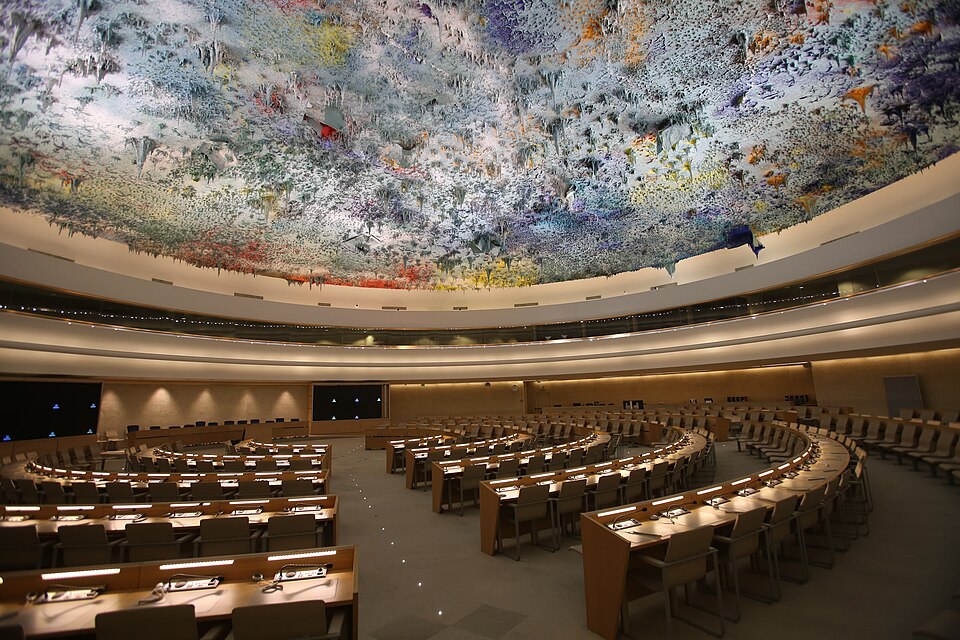
Featured image: International Criminal Court, The Hague, 12 May 2019 (file photo). Photo: OSeveno / Wikimedia Commons, CC BY-SA 3.0. Resized. Thumbnail crops are also licensed under CC BY-SA 3.0.
Article 1
US Sanctions Against the ICC, Navi Pillay’s Nobel Peace Prize and the Crisis of Institutional Legitimacy
RAW TRUTH MEDIA | GLOBAL POWER & INSTITUTIONS
Analysis & Opinion | International Law and Global Governance
International justice was conceived as a safeguard against impunity. Its institutions were created to ensure that the gravest violations of international law would not escape accountability simply because national governments were unwilling or unable to act.
Yet an increasingly urgent question remains insufficiently examined: who holds the institutions of international justice accountable when their own legitimacy, impartiality and credibility become subjects of international dispute?
On 9 October 2026, that question acquired renewed significance.
The United States imposed sanctions on the International Criminal Court as an institution, escalating its longstanding confrontation with the Court. Earlier the same day, the Norwegian Nobel Committee announced that the 2026 Nobel Peace Prize had been awarded to Navanethem “Navi” Pillay, a former ICC judge, former UN High Commissioner for Human Rights and former chair of the United Nations Commission of Inquiry investigating Israel and the Occupied Palestinian Territory.
The timing was remarkable.
On one side stood an American administration challenging the jurisdiction and operational independence of an international judicial institution. On the other stood a Nobel Committee honouring a prominent figure associated with international criminal justice and the defence of the global legal order.
These developments represent competing interpretations of what international justice requires. They also expose a deeper institutional dilemma: independence is indispensable to justice, but independence without effective accountability risks weakening the legitimacy it is intended to protect.
Washington’s Confrontation with the ICC
In his 9 October statement, US Secretary of State Marco Rubio announced the designation of the International Criminal Court under Executive Order 14203. The measure extended Washington’s sanctions policy beyond individual judges and prosecutors to the institution itself.
The designation generally restricts transactions with the Court and blocks property or interests in property falling within US jurisdiction, subject to specific authorisations and exemptions. Temporary licensing arrangements included a 180-day period covering certain activities related to the Court’s continued operations.
The American position rests upon a longstanding objection to the ICC’s assertion of jurisdiction over nationals of countries that have not joined the Rome Statute.
The United States signed the Rome Statute in 2000 but never ratified it and subsequently declared that it did not intend to become a party. Washington has consistently challenged the proposition that an international court should be able to exercise criminal jurisdiction over American citizens without the consent of the United States.
The ICC operates according to a different legal framework.
Under Article 12 of the Rome Statute, the Court may exercise jurisdiction where alleged crimes were committed on the territory of a state party or a state that has accepted the Court’s jurisdiction, even when the accused is a national of a non-party state. Jurisdiction may also arise through a referral by the United Nations Security Council.
Non-membership, therefore, does not automatically place a country’s nationals beyond the Court’s reach. Nevertheless, the disagreement raises legitimate and difficult questions concerning sovereignty, treaty consent, territorial jurisdiction and the limits of international institutional authority.
These questions deserve serious legal examination. They should not automatically be dismissed as hostility toward international justice. Equally, a state’s disagreement with the Court’s jurisdiction does not, by itself, establish that the institution has acted unlawfully or illegitimately.
A credible international legal order must be capable of distinguishing genuine jurisdictional disputes from attempts to avoid accountability.
Navi Pillay and the Contested Meaning of International Justice
The Nobel Peace Prize awarded to Navi Pillay introduces another dimension to the debate.
Pillay’s career includes significant contributions to international criminal law and human rights. She opposed apartheid in South Africa, served as a judge at the International Criminal Tribunal for Rwanda and the International Criminal Court, and later became United Nations High Commissioner for Human Rights. The Norwegian Nobel Committee awarded her the prize “for her efforts to promote peace and international law.”

Her record, however, is not viewed uniformly.
Pillay chaired the UN Independent International Commission of Inquiry on the Occupied Palestinian Territory, including East Jerusalem, and Israel. In 2025, the Commission concluded that Israel had committed genocide in Gaza. Israel categorically rejected that finding and accused the Commission of employing predetermined conclusions, discriminatory standards and a methodology shaped by institutional hostility toward the Jewish state.
Following the Nobel announcement, Israeli officials condemned the decision in exceptionally strong terms. Pillay’s defenders, by contrast, presented the award as recognition of her lifelong commitment to international law and accountability, arguing that opposition to the Commission’s findings does not invalidate its evidence or legal analysis.
The divergence is profound. For supporters, Pillay represents the defence of legal institutions against political pressure. For critics, her record illustrates how international authority can legitimise contested conclusions while insulating those responsible from meaningful scrutiny.
This disagreement cannot responsibly be resolved through personal denunciation or institutional prestige.
Criticism of Israeli policy does not automatically constitute antisemitism. At the same time, allegations of discriminatory standards or institutional prejudice should not be dismissed merely because they concern a respected international official. The appropriate questions concern mandate, methodology, evidentiary standards, legal interpretation, consistency and procedural fairness.
No official’s reputation should place their work beyond examination. Nor should political disagreement alone be treated as proof of misconduct.
The Nobel award and the American sanctions therefore reveal an extraordinary divergence in contemporary perceptions of international legal authority. For some, international institutions remain indispensable safeguards against impunity. For others, their expanding influence raises concerns about selectivity, political instrumentalisation and inadequate external accountability.
The challenge is to evaluate those concerns through evidence rather than institutional loyalty or political allegiance.
Different Institutions and Different Forms of Authority
The International Criminal Court, United Nations commissions of inquiry and UN special procedures are not interchangeable.
The ICC is a treaty-based judicial institution with defined jurisdiction, formal proceedings and rules governing evidence, admissibility, appeals and the rights of accused persons. UN commissions of inquiry and fact-finding missions are investigative mechanisms. They may document alleged violations and reach important legal conclusions, but they are not criminal courts and their findings do not constitute criminal convictions.
These distinctions are frequently lost in public discussion.
An allegation submitted to a UN mechanism may be reported as a UN-established fact. A commission’s finding may be presented as though it were a binding judicial judgment. A request for an arrest warrant may be described as proof of guilt. When these different levels of authority are collapsed into one another, public understanding becomes distorted.
International investigative bodies also frequently rely on evidence supplied by witnesses, civil-society networks, nongovernmental organisations, experts and other external sources. These contributions can be indispensable, particularly where access to conflict zones is restricted. Their institutional use nevertheless requires clear standards of source evaluation, independence and corroboration.
A submission from an NGO is not automatically an established fact. Likewise, the appearance of a conclusion in an international report cannot substitute for examination of the evidence and methodology supporting it.
The more influential an international finding becomes, the greater the responsibility to explain how it was reached.
The methodological pathway through which civil-society allegations acquire institutional authority requires separate examination. That question forms the subject of the next article in this series.
When International Institutions Enter Political Conflict
International judicial and investigative institutions were established to advance accountability, protect fundamental rights and contribute to a more stable international order.
Their decisions, however, do not operate in a political vacuum. Judgments, arrest warrants, investigative reports and legal characterisations can influence diplomatic relations, sanctions, military partnerships, public opinion and domestic political debate.
Governments and advocacy organisations may invoke institutional findings selectively to strengthen positions they already hold. In highly polarised conflicts, legal language can become part of a wider struggle for political legitimacy.
This does not mean that an institution acts improperly whenever its conclusions generate controversy. A legally defensible decision can produce intense political consequences. Conversely, an institution may possess a legitimate mandate while remaining vulnerable to procedural weaknesses, inconsistent standards or insufficient transparency.
Both possibilities must remain open to examination.
Defending the rule of law should not require treating the institutions responsible for applying it as infallible. Criticism of institutional shortcomings, however, must not become an excuse for abandoning accountability for genuine violations of international law.
Institutional Independence Is Not Institutional Immunity
The strongest objection to Washington’s sanctions concerns their potential consequences for judicial independence.
The ICC condemned the designation as an attempt to obstruct the course of justice and an assault on the foundations of the international legal order. The sanctions may also affect financial services, technology, investigations, victims, witnesses and the Court’s capacity to conduct its work.
These concerns are substantial. Courts and investigative bodies must be protected from coercion intended to change judicial outcomes or punish officials for decisions made within their legal mandate.
Sanctions, particularly when imposed by a powerful state against a judicial institution, risk creating a precedent in which political and financial power determines which international investigations can continue.
But institutional independence and institutional accountability are not mutually exclusive.
The Rome Statute already provides mechanisms concerning judicial conduct, disqualification, removal from office, appeals and oversight by the Assembly of States Parties. The relevant question is not whether accountability mechanisms formally exist. It is whether they are sufficiently transparent, independent and effective to maintain confidence in the Court’s impartiality and administration.
The same principle applies to UN investigative bodies. Independence must protect judges and investigators from improper political interference. It should not shield mandates, methodologies, evidentiary practices or administrative decisions from legitimate examination.
International justice must be strong enough to resist intimidation and transparent enough to withstand independent scrutiny.
A Crisis of Confidence Years in the Making
The disputes now surrounding international justice are not new. Concerns involving jurisdiction, sovereignty, perceived selectivity, investigative methodology and institutional accountability have developed over decades.
What has changed is the scale of the confrontation.
A major power has now imposed sanctions on the ICC itself, while the world’s most prominent peace prize has honoured a jurist closely associated with the international legal system that Washington and Israel increasingly challenge.
This confrontation reflects more than disagreement over particular cases. It reveals a broader deterioration of confidence.
Could stronger independent oversight, clearer investigative procedures and a greater willingness to engage with substantive criticism have reduced the present tensions? There is no simple answer. Some attacks on international institutions are plainly motivated by a desire to obstruct accountability. Other criticism exposes genuine questions about authority, consistency and institutional design.
A credible system must be capable of distinguishing between the two.
Trust cannot be maintained through appeals to authority alone. It must be earned through transparent reasoning, consistent legal standards, procedural integrity and demonstrated impartiality. When legitimate questions remain unanswered, disputes that might once have been addressed through legal and diplomatic mechanisms can escalate into direct institutional confrontation.
The Future of International Justice
Supporters of the ICC warn that weakening the Court risks undermining accountability for genocide, crimes against humanity, war crimes and the crime of aggression. That warning deserves to be taken seriously.
At the same time, international judicial authority cannot remain credible if legitimate concerns about jurisdiction, selectivity, due process or institutional conduct are treated as inherently illegitimate.
A functioning international justice system requires independent courts, respect for sovereignty within the applicable legal framework, evidentiary integrity, procedural fairness and effective accountability. Sanctions cannot resolve complex legal disagreements concerning jurisdiction or institutional legitimacy. But invoking judicial independence cannot eliminate the responsibility to examine institutional conduct.
The future of international justice should not depend upon choosing between unquestioning institutional loyalty and wholesale rejection of international legal mechanisms.
Institutions must be defended when their independence is threatened, reformed where their procedures are inadequate and scrutinised according to standards as demanding as those they apply to states and individuals.
Conclusion: Who Holds the Guardians Accountable?
The events of 9 October 2026 represent more than a dispute between Washington and The Hague. They expose fundamental tensions within the contemporary international legal order: sovereignty and jurisdiction, independence and oversight, institutional authority and public legitimacy.
The Nobel Peace Prize awarded to Navi Pillay reflects the importance many international actors attach to preserving international law at a time of growing geopolitical confrontation. The American sanctions demonstrate the intensity of opposition that emerges when powerful states reject the authority exercised by international judicial institutions.
Neither development resolves the underlying question.
The world needs institutions capable of investigating the gravest crimes without intimidation from governments or political movements. But those institutions must also demonstrate that their own decisions are based on consistent law, credible evidence, procedural fairness and transparent reasoning.
International justice cannot command lasting legitimacy merely because its mission is morally important. Institutions entrusted with investigating states and individuals must themselves be prepared to answer legitimate questions about their conduct.
The question is not whether the world needs international justice. It does. The question is whether the international legal system can preserve its independence while responding credibly to demands for greater accountability.
Because no institution entrusted with administering justice should consider itself beyond accountability.
Sources and Further Reading
• Norwegian Nobel Committee, “Nobel Peace Prize 2026 – Press Release,” 9 October 2026
• United States Department of State, “Imposing Sanctions on the International Criminal Court,” 9 October 2026
• Executive Order 14203, “Imposing Sanctions on the International Criminal Court,” 6 February 2025
• International Criminal Court, Rome Statute
• International Criminal Court, official institutional statements and documents
• United Nations Commission of Inquiry, statement concerning its findings on alleged genocidal acts in Gaza
• Reuters, “Former ICC Judge Navi Pillay Wins 2026 Nobel Peace Prize,” 9 October 2026
• Associated Press, analysis of the reaction to Pillay’s Nobel Peace Prize and her record at the United Nations
Raw Truth Media | Global Power & Institutions
Editorial note: This article presents an independent analysis of international legal and political developments. It distinguishes documented events from contested allegations and interpretative assessments. The views expressed do not constitute judicial findings or the official position of any institution.



Leave a Reply