
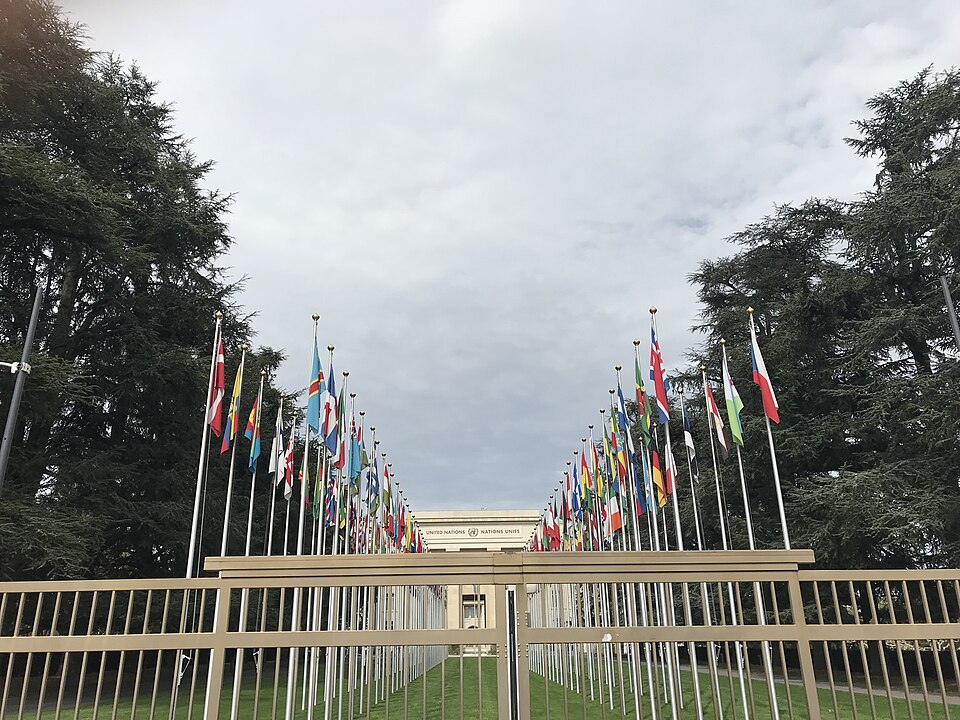
Featured image: Flags outside the Palais des Nations, Geneva, 14 April 2018 (file photo). Photo: Benoît Prieur / Wikimedia Commons, CC0 1.0. Resized.
How NGOs Shape the United Nations’ Version of Reality
Pillar 4 — Global Power & Institutions
Analysis & Opinion | Human Rights, Global Governance and Institutional Accountability
In international politics, facts rarely arrive before the institutions that interpret them. They are collected, translated, classified and repeated through a network of witnesses, activists, non-governmental organisations, journalists, United Nations officials and diplomatic bodies. By the time an allegation reaches a UN report, it may carry the authority of an international institution — even when the public cannot reconstruct the full evidentiary path behind it.
This does not mean that NGO evidence is inherently unreliable. Civil-society organisations frequently reach victims whom governments, journalists and international investigators cannot. In closed societies and active war zones, their documentation may be indispensable. Nor does it mean that every UN finding based partly on NGO material is false.
The real problem is more structural: when advocacy material moves through an opaque institutional chain, repetition can begin to resemble corroboration. A claim made by one local organisation may be cited by an international NGO, repeated by several media outlets, submitted to a UN expert and later appear in an official report. To the reader, this can look like confirmation from multiple sources. In reality, the chain may lead back to a single allegation.
When that distinction is hidden, an information pipeline risks becoming an authority machine.
Why the United Nations Needs NGOs
The contemporary human-rights system could not function without civil society. UN bodies operate across dozens of conflicts and political systems, frequently with limited staff, restricted access and incomplete cooperation from governments or armed groups. NGOs provide local knowledge, witness contacts, legal analysis, photographs, videos, satellite imagery and documentation of alleged violations.
Their role is particularly important when victims fear approaching state institutions or when a government refuses access to international investigators. Testimony gathered by trusted local organisations may offer the only available record of abuse. NGOs can also preserve evidence long before an international mechanism is established.
But usefulness is not the same as neutrality.
An NGO may have a legitimate humanitarian mission while also pursuing a political or legal objective. It may campaign for sanctions, international prosecutions, diplomatic recognition or changes in military policy. It may rely on funding from governments or foundations with their own priorities. It may work almost entirely with one affected community and therefore see only one part of a conflict. None of these factors automatically invalidates its evidence. They do, however, make methodological scrutiny essential.
Evidence should be assessed according to how it was obtained, preserved and corroborated—not according to the moral prestige of the organisation presenting it.
What the UN’s Own Rules Require
The United Nations is not unaware of this danger. The Office of the High Commissioner for Human Rights has developed extensive guidance for commissions of inquiry, fact-finding missions and human-rights officers.
That guidance requires investigations to be independent, impartial, objective and methodologically consistent. Alleged violations by all relevant parties should be examined with equal seriousness. Investigators are expected to collect information from a broad and diverse range of sources, including victims, eyewitnesses, alleged perpetrators, government authorities, NGOs, international organisations, experts, media and documentary material.
Crucially, the guidance distinguishes between the reliability of a source and the validity of the information supplied by that source. A generally respected organisation can still provide inaccurate information. A biased source can still provide truthful and valuable evidence. Institutional reputation is therefore not a substitute for verification.
The same methodology recognises a distinction between primary and secondary sources. A victim, eyewitness, investigator’s direct observation or admission by an alleged perpetrator may constitute primary information. NGO reports and media accounts are often secondary material, especially when their authors did not directly witness the relevant event.
UN guidance also stresses corroboration. As a general practice, investigators should seek concurring information from independent and reliable sources, while recognising that this may be difficult in cases involving torture, sexual violence or inaccessible locations. Documentary and digital evidence should retain information about its origin, collector and date. The integrity of the collection process — including possible bias — must itself be evaluated.
These are serious safeguards. The difficulty is determining, from a published report, how consistently they were applied.

The Difference Between Repetition and Corroboration
Suppose a local activist records an anonymous allegation. Organisation A includes it in a briefing. Organisation B cites that briefing. A news article quotes Organisation B. Organisation C then submits both the news article and the original briefing to a UN mechanism.
There may now be four documents, three organisations and one media reference — but still only one underlying source.
This is the problem of circular citation. Sources appear independent at the level of publication while remaining dependent at the level of origin. Unless investigators trace each claim back through the citation chain, apparent corroboration can be illusory.
The problem becomes more serious when reports use vague formulations such as “multiple sources indicate,” “human-rights organisations have documented” or “credible reports suggest” without identifying whether those sources are genuinely independent. Confidentiality may be necessary to protect witnesses, but it also prevents the public from independently examining important parts of the evidentiary basis.
Confidential evidence should not automatically be rejected. Victims and witnesses may face retaliation, imprisonment or death if identified. Yet protection and accountability must coexist. A credible institution should still explain, as far as safely possible, the type of source relied upon, whether the source had direct knowledge, how independence was assessed and what corroboration existed.
Without that information, outsiders are effectively asked to trust the institution’s conclusion without being able to test its reasoning.
From Advocacy Language to Institutional Language
There is another transformation that occurs inside the pipeline: the movement from advocacy language to official language.
NGOs are not courts. Many are created to campaign, persuade and mobilise. Their publications may be designed not only to document events but also to produce political action. Terms carrying specific legal meanings — such as apartheid, starvation, collective punishment, ethnic cleansing or genocide — can therefore enter public discourse through organisations that are simultaneously evidence gatherers and advocates.
When a UN mandate-holder or commission repeats that terminology, the claim acquires a different status in the public imagination. Headlines may present the statement as a determination by “the United Nations,” even where it was made by an independent expert, a temporary commission or a body applying a lower evidentiary threshold than a court.
The distinction matters. UN commissions of inquiry are investigative mechanisms, not criminal courts. They generally do not apply the criminal standard of proof beyond reasonable doubt. Their findings may rely on standards such as reasonable grounds to believe. Such standards can be appropriate for fact-finding and early warning, but they should not be confused with a final judicial determination of individual or state responsibility.
Once institutional language enters political communication, however, qualifications often disappear. “Reasonable grounds to believe” becomes “the UN proved.” An expert allegation becomes “the UN ruled.” A disputed legal characterisation becomes an established fact repeated by politicians, media outlets, universities and other NGOs.
Institutional authority travels faster than methodological nuance.
Access Restrictions Create Real — but Unequal — Risks
Governments often accuse international mechanisms of bias while simultaneously denying investigators access, refusing interviews or withholding evidence. This creates an obvious contradiction. A state that blocks scrutiny cannot then credibly complain that investigators heard primarily from its opponents.
Yet restricted access also creates a methodological vulnerability. When investigators cannot visit relevant locations, inspect physical evidence, interview officials or examine military records, they become more dependent on remote testimony, open-source material and intermediaries. If most accessible intermediaries belong to a closely connected advocacy network, the diversity of published organisations may conceal a narrow information base.
This is particularly dangerous in armed conflicts, where every party has an incentive to influence international opinion. Images can be miscaptioned. Casualty categories can be contested. Witnesses may be traumatised, politically committed or fearful. Authorities may conceal wrongdoing. Armed groups may intimidate local reporters. Governments may selectively release intelligence. NGOs may interpret uncertain facts through an established institutional position.
The answer is not to exclude civil society. It is to demand greater transparency about the limitations created by access, source concentration and incomplete verification.
The Funding and Network Question
Source evaluation must also consider institutional relationships.
International advocacy is often organised through networks. NGOs share researchers, campaigns, legal strategies, donors, institutional partners and source material. Some organisations submit joint letters or coordinate recommendations before UN sessions. This cooperation can increase efficiency and amplify neglected voices. But it can also create an echo chamber in which closely connected actors are treated as separate confirmation of the same claim.
Funding does not by itself discredit evidence. Governments fund NGOs with which they sometimes disagree, and private donors support legitimate documentation across the political spectrum. Nevertheless, transparency requires disclosure of material relationships that could affect institutional incentives.
If a government finances an NGO that campaigns for a policy favoured by that government, the relationship is relevant. If several organisations cited as independent sources rely on the same original researchers, the overlap is relevant. If a UN mechanism regularly consults a particular advocacy network while comparable organisations with different perspectives are excluded, that imbalance is relevant.
The question is not simply, “Who paid for the report?” It is: “What relationships shaped the production, selection and circulation of the information?”
Why This Matters Beyond a Single Conflict
The consequences extend far beyond institutional reputation. UN reports can influence sanctions, arms restrictions, diplomatic recognition, corporate decisions, university policies and international litigation. They may be quoted by domestic courts, prosecutors and parliamentary committees. Even when a report is not legally binding, it can alter the political environment in which legal decisions are made.
Errors therefore have a long institutional life. A weakly verified allegation can move from NGO report to UN document, from UN document to media coverage, and from media coverage into political speeches and academic literature. Later publications may cite the institutional report rather than the uncertain original source. The claim becomes progressively harder to question because each repetition adds a new layer of apparent authority.
This does not require conspiracy. Institutional systems can produce distorted outcomes through ordinary incentives: time pressure, limited resources, restricted access, professional networks, ideological conformity and the understandable desire to respond rapidly to alleged atrocities.
But the absence of conspiracy does not remove the need for accountability.
What Meaningful Reform Would Look Like
Restoring confidence requires more than declarations of independence and impartiality. International fact-finding bodies should provide a visible methodological audit trail without exposing vulnerable witnesses.
First, reports should classify their evidence more clearly: direct testimony, secondary reporting, open-source intelligence, NGO documentation, government material or expert analysis. Readers should be told when several citations derive from the same original source.
Second, investigative mechanisms should disclose their criteria for selecting NGO partners and explain how they evaluated organisational independence, methodology and possible conflicts of interest.
Third, commissions should publish meaningful source-diversity information: not the identities of protected witnesses, but the categories, geographic distribution and degree of independence of the sources consulted.
Fourth, reports should separate factual findings, legal analysis and advocacy recommendations. Readers must be able to see where documented events end and contested legal interpretation begins.
Fifth, mechanisms should disclose the standard of proof applied to each major finding and explain what that standard means. A public unfamiliar with legal terminology should not be permitted — or encouraged — to mistake a provisional assessment for a criminal conviction.
Sixth, UN bodies should create transparent procedures for correcting material errors. Institutional credibility depends not on claiming infallibility, but on demonstrating the capacity for self-correction.
Finally, commissions must actively seek evidence from politically, ethnically and religiously diverse sources, including voices that challenge the dominant institutional narrative. Impartiality is not achieved by removing disagreement. It is tested by engaging with it.
Accountability Must Apply to the Fact-Finders
Human-rights investigations exist because power must be scrutinised. The same principle must apply to the institutions conducting that scrutiny.
NGOs remain essential to documenting violations, protecting victims and bringing neglected evidence into the international system. The United Nations also retains an indispensable role in investigating abuses that national institutions cannot or will not address. But moral purpose does not eliminate methodological risk, and institutional prestige does not convert every allegation into fact.
The public should not be forced to choose between unquestioning trust in international institutions and wholesale rejection of human-rights reporting. A mature system makes room for a third position: principled scrutiny.
The decisive question is not whether an allegation originated with an NGO. It is whether the original evidence can be traced; whether apparently separate sources are genuinely independent; whether contradictory information was examined; whether the relevant standard of proof was disclosed; and whether the conclusion remains proportionate to the evidence.
When those questions cannot be answered, repetition must not be mistaken for verification.
International institutions derive their authority from the belief that they stand above political advocacy. Preserving that authority requires more than good intentions. It requires transparent methods, intellectual independence and the willingness to subject the fact-finders themselves to scrutiny.
Because in a system capable of turning allegations into international facts, accountability must begin before the conclusion is written.
Selected institutional sources
• Office of the UN High Commissioner for Human Rights, Commissions of Inquiry and Fact-Finding Missions on International Human Rights and Humanitarian Law: Guidance and Practice, HR/PUB/14/7.
• Office of the UN High Commissioner for Human Rights, Manual on Human Rights Monitoring, Chapter 7, “Gathering Contextual Information.”
• United Nations Human Rights Council, overview of international commissions of inquiry and fact-finding missions.
• Office of the UN High Commissioner for Human Rights, guidance concerning individual communications and civil-society engagement with UN human-rights mechanisms.



Leave a Reply