

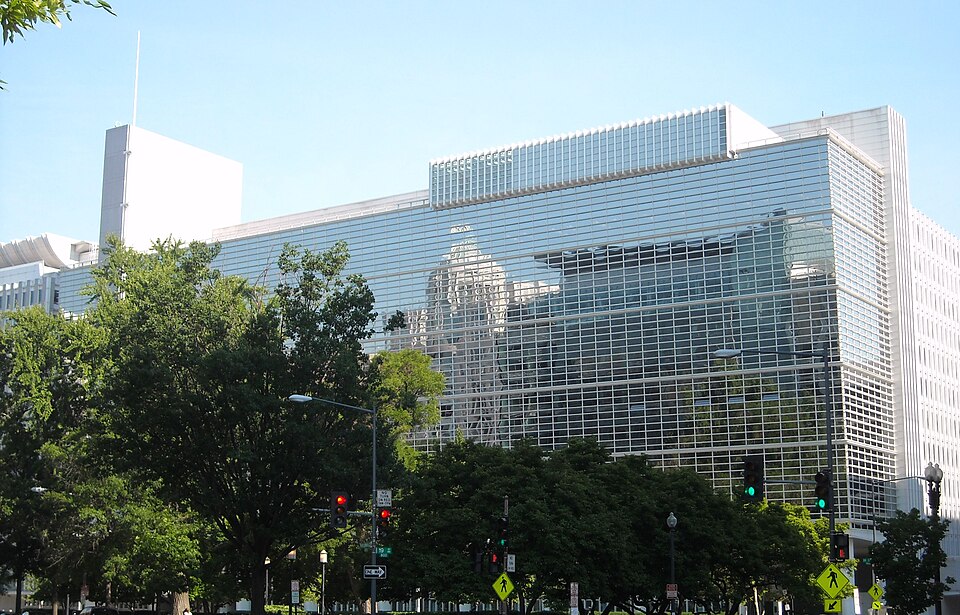
Featured image: World Bank Group building in Washington, D.C., May 2008 (file photo). Photo: AgnosticPreachersKid / Wikimedia Commons, CC BY-SA 3.0. Resized. Thumbnail crops are also licensed under CC BY-SA 3.0.
Who Really Controls the Global Aid System?
RAW TRUTH MEDIA | GLOBAL POWER & INSTITUTIONS
Analysis & Opinion | International Development, Sovereignty and Global Governance
International development is usually presented as a partnership. Wealthier states, multilateral institutions and international organisations provide finance, expertise and technical support. Recipient governments identify national priorities, implement reforms and build institutions capable of improving people’s lives.
In principle, the arrangement combines resources with local knowledge.
In practice, the relationship is rarely equal.
Money arrives through loan agreements, policy conditions, donor strategies, reporting frameworks and predetermined indicators. Governments facing debt crises or foreign-exchange shortages negotiate under pressure. Local organisations redesign programmes to match available grants. Ministries learn the language preferred by donors. Entire policy sectors can become organised around what international institutions are willing to finance rather than what communities identify as their most urgent need.
This does not mean that international assistance is inherently exploitative. Development finance has supported vaccination, education, infrastructure, agricultural production, institutional reform and emergency recovery across the world. Countries in severe crisis may have few credible alternatives to external support. Conditions attached to finance can also protect public money, encourage transparency and prevent governments from postponing necessary reforms.
But assistance becomes politically consequential when access to essential finance depends upon accepting policies designed, assessed or approved outside the country receiving it.
The central question is therefore not whether development assistance should have standards. It is who defines those standards, who bears the cost of compliance and who remains accountable when externally supported reforms fail.
The Power Hidden Inside Development Finance
Development institutions do not need direct political control over a country to influence its choices. Financial dependence can shape policy more subtly.
The International Monetary Fund lends to countries facing balance-of-payments problems and broader macroeconomic instability. The World Bank finances projects, public institutions and policy reform. Bilateral donors support sectors aligned with their foreign-policy and development priorities. United Nations agencies manage programmes funded largely through contributions from governments. International NGOs operate through grants whose objectives are normally established before local implementation begins.
Each actor has a distinct mandate. Yet all exercise power through decisions about eligibility, timing, priorities, acceptable risk and measurable success.
The influence is greatest during crisis.
A government negotiating while its currency collapses, its reserves disappear or its debt obligations become unmanageable does not possess the same bargaining power as the institution capable of releasing emergency finance. Formally, the government consents. Economically, its range of realistic alternatives may be extremely narrow.
Consent under pressure is still consent in legal and diplomatic terms. But it is not the same as a negotiation between equal partners.
Why Conditions Exist
Conditionality is not an accidental feature of international lending. It is part of its design.
The IMF explains that policy conditions are intended to ensure that a borrowing country adopts measures capable of resolving the problems that produced its financing need and of enabling repayment. These conditions may include prior actions required before financing is approved, quantitative performance criteria concerning reserves, fiscal balances or borrowing, and structural benchmarks used to assess reforms.
The logic is understandable. International institutions manage resources contributed by member states. Lending without an economic programme could finance unsustainable policies, delay reform or transfer the cost of domestic political decisions to external creditors.
The World Bank’s development policy financing operates through a related model. Funds may be released after governments complete agreed “prior actions”—legal, regulatory or institutional measures considered necessary for the supported development programme.
Conditions can address real problems: opaque public procurement, unsustainable subsidies, weak tax collection, politically controlled state enterprises or public budgets that consistently exceed available revenue.
The difficulty begins when a financing institution moves from protecting the viability of a programme to determining the acceptable direction of national policy.
A requirement to publish public accounts is not equivalent to requiring a particular model of pension reform. An anti-corruption safeguard is not the same as specifying how quickly energy prices must be liberalised. Establishing independent auditing is different from prescribing the scale and timing of fiscal contraction.
All may be described as reform. Their democratic and social implications are not the same.

Country Ownership: The Principle Everyone Supports
The international development community formally recognises this problem.
The 2005 Paris Declaration on Aid Effectiveness placed country ownership at the centre of effective development cooperation. It called for recipient countries to exercise leadership over their development strategies while donors aligned their support with national priorities and institutions. The Declaration also emphasised harmonisation, results and mutual accountability.
The language changed the way development partnerships were discussed. Programmes were no longer supposed to be imposed from outside. Governments would lead, donors would align and all parties would share responsibility for outcomes.
Yet ownership is more difficult to establish than to declare.
Who represents the country in a negotiation? A finance minister? The executive? Parliament? Local government? Trade unions? Farmers? Women’s organisations? Religious institutions? Communities affected by a project?
A programme may be “country-owned” because a national government signed it, even when the agreement received little parliamentary scrutiny and the communities expected to absorb its costs were never consulted.
Governments themselves are not neutral expressions of national interest. Political elites may welcome external conditions that allow them to implement unpopular measures while attributing responsibility to international institutions. Donors can then describe those same measures as nationally owned because the government formally accepted them.
Ownership can therefore become a diplomatic fiction maintained by both sides.
Crisis Negotiation and the Narrowing of Democratic Choice
Economic crises require difficult decisions. Governments may need to reduce deficits, restructure debt, reform subsidies or increase revenue. The existence of hardship does not mean that every adjustment programme was externally imposed or that fiscal restraint is unnecessary.
The political question concerns who chooses the distribution of sacrifice.
A fiscal target can be met in different ways: reducing public-sector wages, cutting infrastructure, reforming tax exemptions, increasing progressive taxation, reducing military spending, changing pension entitlements or improving revenue enforcement. These choices affect social groups differently.
When an external programme strongly privileges one route, democratic debate can become compressed. Elections may change the government without substantially changing the economic framework because access to financing remains conditional on maintaining previously negotiated commitments.
The result is not the disappearance of sovereignty, but its narrowing.
Ukraine’s recent negotiations with the IMF illustrate that conditions are not always mechanically imposed. In 2026, the parties revised elements of a lending programme, including sensitive tax measures, demonstrating that conditionality can be negotiated and adapted. At the same time, IMF approval remained important for unlocking wider international financial support. The example shows both national agency and the structural leverage attached to institutional approval.
The relationship is therefore more complex than domination on one side and submission on the other. It is negotiated—but negotiated within a system in which one party controls access to urgently needed capital.
The Social Cost of Macroeconomic Success
International financial programmes are frequently assessed through indicators such as inflation, reserves, deficit reduction, debt sustainability and economic growth. These measures matter. A state cannot fund health, education or social protection indefinitely without a functioning economy.
But macroeconomic stabilisation is not identical to human development.
A programme may meet fiscal targets while hospitals lose staff, households absorb higher energy prices or local businesses face collapsing demand. A reduction in public expenditure can improve the government’s accounts while increasing unpaid care work inside families. Privatisation may raise short-term revenue while reducing access to essential services in rural or low-income communities.
Aggregate indicators can conceal how adjustment costs are distributed by income, gender, age, disability and geography.
This is particularly important for women. When public services are reduced, unpaid responsibilities often shift into the household. Women compensate for gaps in childcare, elder care, health provision, water access and food security. These effects may remain invisible in the fiscal indicators used to declare a programme successful.
The question is not whether macroeconomic stability matters. It is whether stability achieved by transferring costs to those with the least political influence should be described as successful development.
When Donors Define the Problem
Influence does not operate only through major loans. It also appears in the everyday architecture of grants.
Donors normally fund specific priorities: climate resilience, gender equality, digital governance, migration management, anti-corruption, reproductive health, conflict prevention or another defined sector. These priorities may address urgent needs. They also create incentives for governments, universities and NGOs to describe local problems in ways that correspond to available funding.
An organisation working in a rural community may identify irrigation, transport or market access as the primary concern. If grants are available mainly for digital inclusion or gender programming, the organisation may redesign its proposal around those categories. The resulting project may still produce value, but the funding system has influenced which problem became institutionally visible.
This phenomenon is sometimes called mission drift. Organisations gradually adapt their objectives to the preferences of funders because survival depends upon successful applications.
The influence continues through measurement. Donors may require indicators that are easily aggregated across countries: participants trained, workshops held, policies adopted or beneficiaries reached. Local actors learn to produce the outputs that reporting systems reward.
What is easier to measure can become more important than what is harder to transform.
Training sessions are counted. Institutional trust is not. Policies are adopted. Implementation remains uncertain. A school is built. Whether qualified teachers remain in the community receives less attention. Women are enrolled in a programme. Whether they acquire control over land, income or household decisions may take years to establish.
Development then risks becoming a system that rewards visible activity rather than durable change.
The NGO Intermediary System
Large international NGOs occupy an influential position between donors and communities.
They can provide technical expertise, financial management, international advocacy and the administrative capacity required to operate complex programmes. In emergencies, their logistical networks can save lives.
But the intermediary model can also reproduce hierarchy.
Funding often moves from a government donor or multilateral institution to an international organisation, then to a national NGO and finally to a local partner. At each stage, resources support administration, compliance, monitoring and reporting. The organisation closest to the community may receive only a fraction of the original grant while carrying much of the implementation risk.
Local partners may be described as essential while remaining subcontractors rather than decision-makers. They provide access, language, legitimacy and contextual knowledge but may have limited influence over programme design, budget allocation or public communication.
When a project succeeds, the international organisation reports the result to the donor. When it fails, local capacity is frequently identified as the weakness.
This imbalance helps explain the growing demand for localisation: more direct funding to national and community organisations, greater control over programme design and fewer layers of international intermediation.
Yet localisation cannot be reduced to transferring administrative responsibility without transferring authority and resources. A local organisation is not empowered merely because it is asked to implement a programme designed elsewhere.
Funding and Institutional Loyalty
Dependence upon external finance can also affect what organisations are willing to say.
An NGO whose budget depends upon a small number of donors may hesitate to challenge donor policy. A research centre may select questions likely to receive grants. A government ministry may prioritise reforms that improve its relationship with external institutions. UN agencies financed through voluntary contributions may expand programmes aligned with donor preferences while less fashionable needs remain underfunded.
This does not require explicit censorship. Institutions adapt to incentives.
The effect can be especially pronounced when funding is earmarked. Earmarked contributions allow donors to specify the programme, country or issue for which their money may be used. This increases donor control but reduces the ability of international organisations to allocate resources according to independently assessed need.
The largest government donors consequently exercise influence not only through formal voting arrangements but through decisions about what they are willing to finance.
The result is a paradox. International institutions are expected to serve universal objectives while relying heavily on states whose contributions reflect national priorities.
When Conditionality Can Serve the Public Interest
A serious critique of conditional development must also recognise why conditions sometimes protect citizens.
Governments may borrow irresponsibly, conceal public debt, divert development funds or maintain subsidy systems that disproportionately benefit wealthy and politically connected groups. Public enterprises can become sources of patronage. Procurement contracts may reward party allies rather than deliver public services.
In such circumstances, external requirements concerning audit, procurement transparency, beneficial ownership, debt disclosure or independent regulation can strengthen domestic reformers and protect public resources.
Conditionality can also give governments political cover for measures they know are necessary but fear implementing alone. A carefully designed programme can help restore currency stability, rebuild reserves and create the conditions for long-term investment.
The relevant distinction is not between unconditional aid and conditional oppression. It is between conditions that protect the integrity of public finance and conditions that unnecessarily replace democratic policy choice.
Good conditionality should be limited, transparent, evidence-based and directly connected to the problem the financing is intended to address. It should protect essential social expenditure and allow governments to choose among credible policy alternatives rather than prescribe a single ideological model.
Most importantly, the institution imposing conditions should also be accountable for the advice it provides.
When a programme fails, responsibility should not automatically be assigned to deficient local implementation. Programme design, unrealistic timelines, faulty assumptions and underestimated social consequences must also be examined.
Mutual accountability cannot mean that donors claim credit for success while recipient countries own every failure.
Development as a Form of Global Governance
Development finance is often treated as technical assistance. In reality, it is also a form of governance.
Institutions influence tax systems, public-sector employment, energy markets, environmental regulation, social protection and the relationship between states and private capital. These are not merely technical domains. They involve competing values and determine how resources, risks and opportunities are distributed across society.
Technical expertise remains essential. Governments should not reject sound economic analysis merely because it comes from abroad. But expertise does not eliminate politics. Every reform creates winners, losers and trade-offs.
The language of technical necessity can conceal those choices.
When a policy is presented as the only responsible option, disagreement is easily characterised as ignorance, populism or resistance to reform. Yet experts themselves operate within institutions shaped by professional assumptions, lending mandates and political constraints.
Democratic accountability requires that citizens be allowed to debate not only whether reform is necessary, but which reform, at what speed and at whose expense.
What Genuine Ownership Would Require
If international development is to operate as a partnership rather than a hierarchy, country ownership must become more than a phrase in donor documents.
First, major financing agreements should receive meaningful parliamentary scrutiny. Governments should publish the conditions, assumptions and projected social effects before irreversible commitments are made.
Second, recipient countries should be offered policy space. International institutions may establish objectives—such as debt sustainability or transparent procurement—without prescribing every instrument used to achieve them.
Third, social-impact analysis should carry weight equal to macroeconomic targets. Health, education, gender equality, food security and regional inequality should not be treated as secondary consequences to be addressed after stabilisation.
Fourth, local governments, civil society, community organisations and affected groups should participate before a programme is designed, not merely during implementation.
Fifth, more funding should reach local organisations directly, accompanied by long-term investment in institutional capacity rather than short project cycles.
Sixth, donors and lenders should publish independent evaluations of their own performance. These should examine whether the original policy assumptions were correct and whether programme failures resulted from local non-compliance, external shocks or defective design.
Finally, exit should be recognised as a measure of success. Development institutions should seek to reduce long-term dependency rather than create permanent systems of external supervision.
The purpose of assistance should be to expand a country’s capacity to govern itself—not to institutionalise its need for approval.
Conclusion: Partnership or Managed Dependency?
International assistance can save lives, restore economies and help governments build institutions they could not finance alone. Rejecting it wholesale would harm many of the people critics of the aid system claim to defend.
But good intentions do not neutralise power.
The institution that controls access to finance can influence which reforms occur, how quickly they are implemented and whose interests receive protection. The donor that defines eligible priorities can shape what governments and NGOs recognise as a fundable problem. The organisation that selects the indicators can influence what the world later understands as success.
Development becomes dependency when countries cannot meaningfully reject external prescriptions without losing access to essential resources. It becomes partnership when finance strengthens domestic institutions while preserving political agency, public debate and accountability to citizens.
The global aid system does not need to abandon standards. It needs to apply them in both directions.
Recipient governments must account for public money, corruption and policy failure. Donors and international institutions must account for unequal bargaining power, flawed programme design and the social consequences of their conditions.
The decisive question is not whether a reform was accepted by a government under pressure. It is whether citizens understood it, debated it and retained meaningful power over the development path taken in their name.
Because development cannot credibly claim to empower people while the most important decisions remain controlled by those who finance it.
Sources and Further Reading
• International Monetary Fund, “IMF Conditionality”
• International Monetary Fund, “IMF Lending”
• World Bank, Development Policy Financing
• Paris Declaration on Aid Effectiveness: Ownership, Harmonisation, Alignment, Results and Mutual Accountability
• World Bank Research Observer, “IMF Conditionality and Country Ownership of Adjustment Programs”
• United Nations System Chief Executives Board, revenue by government donor
• International Monetary Fund, Global Public Finance Partnership
• Reuters, “IMF review calls for fewer but deeper reforms in design of loan programs,” 24 September 2026
Raw Truth Media | Global Power & Institutions
Editorial note: This article examines structural power within international development finance. It does not suggest that all aid conditions are illegitimate or that recipient governments bear no responsibility for domestic policy choices.



Leave a Reply