In the heart of Europe, two vastly different approaches to rural development are unfolding. Switzerland, a nation renowned for its stability and foresight, is actively investing in the revival of its villages. Through generous programs and innovative policies, the Swiss government is attracting new settlers—often foreign families—by offering subsidies, tax incentives, and even relocation grants to repopulate and rejuvenate their rural communities.
Meanwhile, in Romania—a country blessed with fertile land, rich traditions, and an invaluable rural heritage—its political elites appear determined to achieve the exact opposite: the systematic dismantling of the Romanian village.
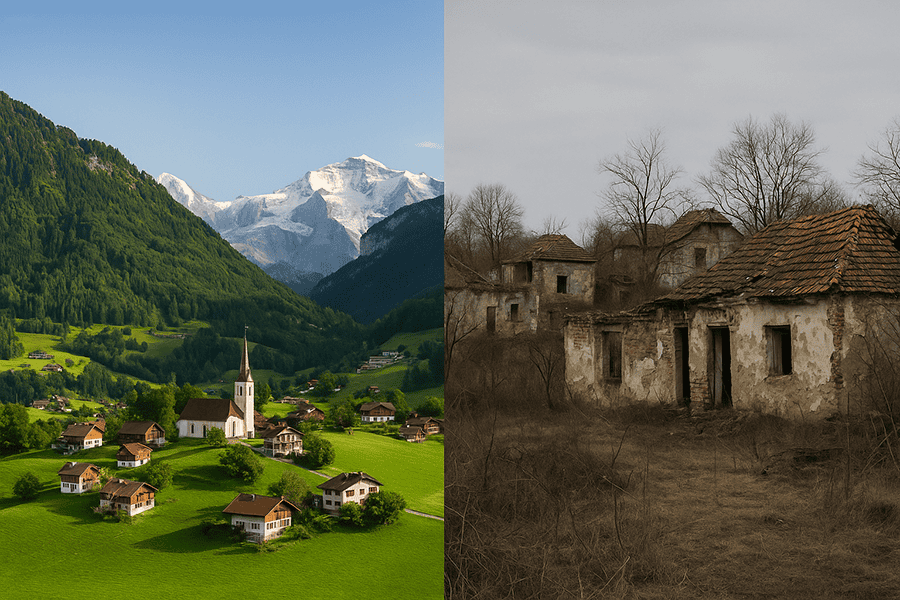
Switzerland’s Vision: Rural Life as a National Asset
In Switzerland, rural communities are considered the backbone of cultural and economic resilience. Entire cantons are rolling out programs designed to breathe life back into villages threatened by depopulation. These include:
- Financial support for new residents willing to move to remote villages, including outright grants for home purchases or renovations.
- Subsidized childcare and education to ensure families can thrive outside urban centers.
- Tax incentives for small businesses to operate in rural areas, thereby creating sustainable local economies.
Swiss policymakers understand what many in Bucharest have either forgotten—or intentionally ignored: a nation’s soul lives in its villages. Its traditions, food sovereignty, natural resources, and cultural continuity are safeguarded in rural communities. Strengthening them ensures a nation’s longevity
Romania’s Assault on Its Villages
Contrast this with Romania’s latest policy: the so-called “school consolidation” initiative, which seeks to close down rural schools and relocate children to urban centers. Marketed as a measure of “efficiency,” the policy is, in reality, a devastating blow to rural life.
Closing a school in a village is not simply an administrative act—it is the death knell of that community. Schools are the heart of village life, hubs of education, culture, and social interaction. Remove them, and you accelerate the exodus of young families, sealing the fate of entire regions.
What makes this policy particularly insidious is the motive behind it. Reports have surfaced that the Romanian government is preparing to purchase electric school buses at inflated prices—three times higher than their market value—to ferry children from depopulated villages to distant urban schools. This is not about improving education. It is yet another state-sponsored money laundering scheme, exploiting European “green transition” funds under the pretext of modernization.
Erasing a Nation’s Identity
These measures are not isolated. They are part of a broader pattern of cultural and demographic sabotage. The Romanian village, long a symbol of resilience and identity, is being deliberately hollowed out. The consequences are profound:
- Loss of Cultural Continuity: Traditional crafts, music, agricultural practices, and community rituals vanish when villages die.
- Economic Dispossession: As locals leave, fertile land and resources fall into the hands of foreign corporations and speculators.
- National Insecurity: A nation that cannot feed itself, rooted in its own soil, is a nation enslaved to outside interests.
Unlike Switzerland, which views its rural heartland as a strategic national asset, Romania’s ruling class seems intent on liquidating its heritage for short-term profit
The Global Context: A Deliberate Strategy?
Some may dismiss this as incompetence or corruption. But when examined in the context of broader global trends—centralized control, land grabs, and the dismantling of self-sufficient communities worldwide—the pattern becomes clearer.
Destroying rural communities weakens national identity and sovereignty. It turns independent citizens into urbanized dependents, easier to control, easier to manipulate. It is not just a policy failure; it is an attack on the very foundations of freedom.
What Must Be Done
Romanians must recognize what is at stake. This is not simply about schools or buses; it is about whether the Romanian village—and, by extension, the Romanian nation—will survive the next generation.
- Expose the Corruption: Demand full transparency on the school consolidation program and the overpriced electric bus contracts. Every document, every invoice, every tender must be made public.
- Defend Local Institutions: Schools, churches, and community centers must be legally protected as essential cultural infrastructure.
- Mobilize Communities: Villagers must organize, form associations, and challenge these policies in courts, in the media, and on the streets.
- Reframe Rural Life as National Security: Like Switzerland, Romania must understand that a strong rural backbone is not nostalgic romanticism—it is a strategic necessity.
If Switzerland can see the value of its villages, why can’t Romania? Or perhaps the better question is: why won’t Romania’s leaders allow Romanians to see it?
The future of the Romanian village is the future of Romania itself. To abandon it is to abandon our sovereignty, our identity, and our survival.