

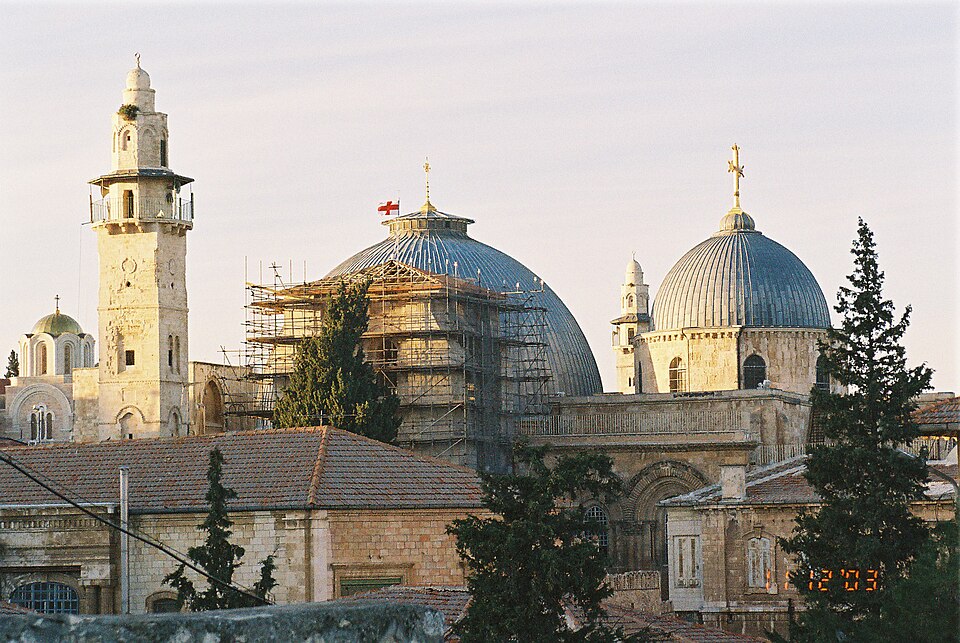
Featured image: The Church of the Holy Sepulchre in Jerusalem’s Old City, 11 December 2003 (file photo). Photo: Lior Golgher / Wikimedia Commons, CC BY-SA 2.5. Resized. Thumbnail crops are also licensed under CC BY-SA 2.5.
At the heart of Jerusalem’s Old City, six Christian communities share one sacred building through a centuries-old institutional arrangement that preserves tradition, regulates power and transforms even the smallest physical action into a question of authority.
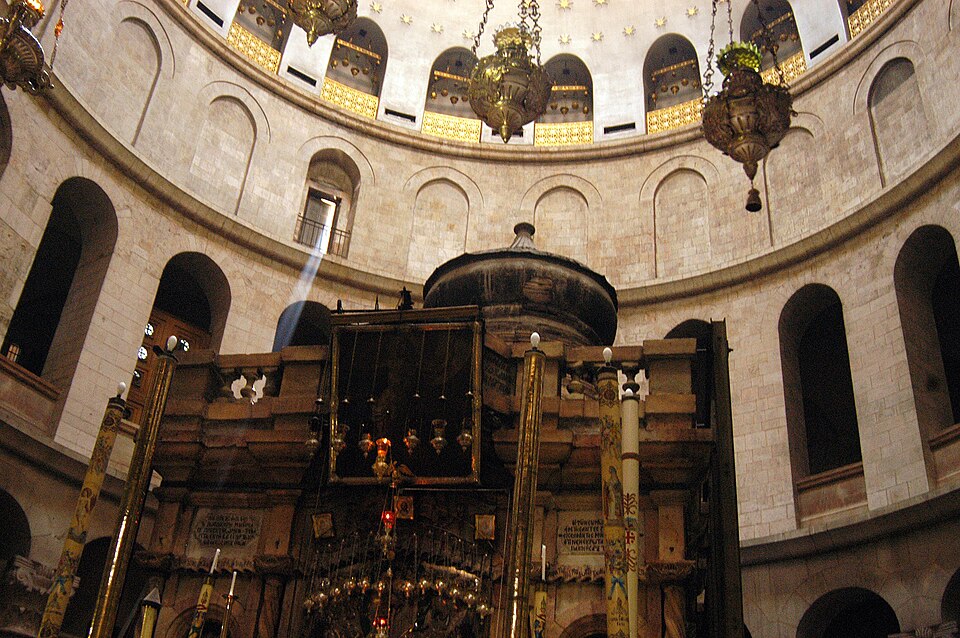
The Church of the Holy Sepulchre occupies a unique position in Christian history and in the religious landscape of Jerusalem. Traditionally identified as the place of the Crucifixion, burial and Resurrection of Jesus Christ, it brings within one architectural complex Golgotha, the Stone of Anointing and the Edicule enclosing the Tomb of Christ. For Eastern Christians, it is commonly known as the Church of the Resurrection or the “Anastasis”, a name that places the theological emphasis not upon the tomb itself, but upon Christ’s triumph over death.
Despite its universal significance, the Holy Sepulchre is not governed by a unified Christian authority. Its sacred spaces are shared by six historic communities whose respective rights, responsibilities and liturgical practices are regulated through a complex institutional framework known as the Status Quo. The Greek Orthodox Patriarchate of Jerusalem, the Franciscan Custody of the Holy Land representing the Roman Catholic Church, and the Armenian Apostolic Patriarchate of Jerusalem possess the most extensive custodial rights. The Coptic Orthodox, Syriac Orthodox and Ethiopian Orthodox communities maintain more limited, but historically and spiritually significant, rights within and around the church.
This arrangement is frequently presented as a relic of Christian rivalry: inflexible, archaic and incomprehensible to outsiders. Yet such a description captures only part of its meaning. The Status Quo has also enabled communities with competing historical claims, distinct theological traditions and different international affiliations to remain within the same sacred institution without being required to submit to a single ecclesiastical authority. It has not eliminated disagreement, nor has it produced complete equality among the communities. Its principal achievement has been to contain disagreement within a recognised system of rights and limitations.
A sacred building shaped by successive empires
The first monumental Christian complex on the site was commissioned by the Roman Emperor Constantine in the fourth century, following the identification of the location traditionally associated with Christ’s Crucifixion and burial. The Constantinian complex was dedicated in 335 and developed into one of the most important pilgrimage destinations in the Christian world.
The church did not remain unchanged. It was damaged, destroyed and reconstructed under successive political authorities. The Persian invasion of Jerusalem in 614 caused extensive destruction, although parts of the complex were subsequently restored. In 1009, the Fatimid Caliph al-Hakim ordered the destruction of much of the church. Byzantine reconstruction followed during the eleventh century, while the Crusaders later reorganised the site and brought its principal sacred locations within the architectural structure that, despite numerous later alterations, broadly defines the church encountered today.
The physical fabric of the Holy Sepulchre consequently represents more than one historical period. Byzantine, Crusader, Ottoman and modern interventions coexist within the same building. Its architecture records not only the development of Christian worship, but also the wider political history of Jerusalem. Every governing power faced the challenge of administering a site claimed by multiple Christian traditions and connected to powerful external patrons.
As the Byzantine, Latin, Armenian and Oriental Orthodox communities competed for access and authority, questions of religious possession became inseparable from international politics. France presented itself as a protector of Catholic interests, while Russia increasingly supported the Orthodox position. Christian disputes within the Ottoman Empire were therefore not simply theological disagreements among clergy. They became connected to diplomatic rivalries between European powers and to their efforts to expand influence in the Middle East.
The emergence of the Status Quo
The Status Quo should not be understood as a single comprehensive agreement negotiated and signed by all six Christian communities. It developed through a combination of imperial decrees, recognised customs, historical practice and accumulated precedent. Its foundations extend across several centuries, but an Ottoman decree issued in 1757 confirmed an important distribution of possession and use at the Christian holy places. In 1852, Sultan Abdülmecid I issued a further decree preserving the arrangements then in existence.
The purpose of the 1852 decree was not to create an entirely new system. It was intended to prevent further conflict by freezing the existing situation. Rights exercised at the recognised historical moment were to remain in place, and no community could unilaterally extend its authority at the expense of another. The settlement later received international recognition, including through the Treaty of Berlin of 1878, and was subsequently maintained under the British Mandate, Jordanian administration and Israeli control of the Old City after 1967.
The Status Quo does not apply exclusively to the Church of the Holy Sepulchre. Related arrangements regulate the possession and use of other contested sacred places, including the Basilica of the Nativity in Bethlehem and the Tomb of the Virgin Mary in Jerusalem. Nevertheless, the Holy Sepulchre represents its most intricate and symbolically powerful expression.
Within the church, the Status Quo governs the ownership or use of chapels, altars, passages, staircases, courtyards and other spaces. It determines the times at which each community may celebrate its liturgies, the routes followed during religious processions, the sequence in which ceremonies occur and the responsibilities associated with cleaning, maintenance and repair. It also regulates apparently minor actions, including the lighting or replacement of lamps, the placement of furnishings and the opening and closing of particular doors.
These details may appear insignificant when considered apart from their institutional context. At the Holy Sepulchre, however, physical action can serve as evidence of possession. Cleaning a step, repairing a wall or placing an object in a shared space may be interpreted as exercising authority over that location. A practical intervention can therefore create a precedent capable of altering the balance among the communities. The Status Quo protects established rights partly by preventing such precedents from being created unilaterally.
The three principal custodial communities
The Greek Orthodox, Roman Catholic and Armenian Apostolic communities exercise the most extensive responsibilities within the church. Their positions reflect centuries of presence, negotiation and competition, rather than a modern division based upon the numerical size of their congregations.
The Greek Orthodox Patriarchate of Jerusalem holds a particularly prominent position within the Holy Sepulchre. Its principal spaces include the Catholicon at the centre of the church, and it possesses substantial rights at Golgotha, the Edicule and several other chapels. The Brotherhood of the Holy Sepulchre, a monastic fraternity closely associated with the Patriarchate, has historically played a central role in protecting Orthodox interests and maintaining the sacred places under Greek Orthodox custodianship.
The Roman Catholic presence is represented by the Franciscan Custody of the Holy Land. The Franciscans have exercised a formal custodial mission in the region since the Middle Ages and maintain important chapels, altars and liturgical rights throughout the church. Their responsibilities connect the Holy Sepulchre to the wider Catholic world and to the long Franciscan tradition of service at the Christian sanctuaries of the Holy Land.
The Armenian Apostolic Patriarchate of Jerusalem represents another ancient and continuously established Christian presence. Armenian connections with Jerusalem extend back to the early centuries of Christianity, while the Armenian Quarter remains one of the four traditional quarters of the Old City. Within the Holy Sepulchre, the Armenian community possesses significant chapels and liturgical rights and participates, together with the Greek Orthodox and Franciscans, in decisions affecting the principal shared areas.
These three communities are commonly described as the principal custodians of the church. The World Monuments Fund, which has participated in conservation initiatives at the site, similarly identifies the Greek Orthodox, Franciscan and Armenian Apostolic Churches as the three major custodial authorities.
Their relationship should not be understood as a simple partnership under a common administration. Each community preserves its autonomy and guards its recognised rights. Cooperation is therefore negotiated rather than assumed. No one community can treat the Holy Sepulchre as an institution placed exclusively under its authority.
The Coptic, Syriac and Ethiopian presence
The Coptic Orthodox, Syriac Orthodox and Ethiopian Orthodox communities possess fewer recognised rights within the complex, but their presence is essential to the historical and religious identity of the church. Describing them as the “smaller communities” refers only to the extent of their custodial position at the Holy Sepulchre. It does not diminish their antiquity or spiritual importance within Christianity.
The Coptic Orthodox Church, rooted in the ancient Christian tradition of Egypt, maintains a small chapel attached to the western side of the Edicule. Its location brings the Coptic presence into immediate physical proximity to the structure enclosing the Tomb of Christ. The limited dimensions of the chapel contrast with the significance of the Coptic Church as one of the world’s oldest Christian institutions.
The Syriac Orthodox Church worships principally in the Chapel of Saint Joseph of Arimathea and Nicodemus, located behind the Edicule. The community preserves a liturgical tradition expressed in Syriac, a language closely related to the Aramaic associated with Jesus and the earliest Christian communities. Its presence at the Holy Sepulchre therefore connects the church to one of Christianity’s oldest surviving linguistic traditions.
The Ethiopian Orthodox Tewahedo Church maintains its most visible presence on the roof of the Holy Sepulchre, in the monastic complex known as Deir al-Sultan. The Ethiopian community’s rights and living conditions there remain among the most historically contested dimensions of the Status Quo, particularly because of competing Ethiopian and Coptic claims. The modest physical character of the monastery stands in striking contrast to the antiquity and global significance of Ethiopian Christianity.
The position of these three communities demonstrates that the Status Quo does not distribute power equally. It preserves the rights inherited from a particular historical settlement, including the inequalities embedded within that settlement. Its function is primarily conservative: it protects what has been recognised rather than continually redistributing authority according to contemporary principles of equality or representation.
This creates one of the system’s fundamental tensions. Stability depends upon preserving inherited rights, yet the preservation of those rights can also make institutional reform exceptionally difficult.
The regulation of sacred time
The Status Quo governs not only physical territory but also time. Each community possesses recognised periods during which it may conduct prayers, processions and liturgical celebrations at specific locations. Services begin during the night and continue through the morning according to a carefully maintained sequence.
For a visitor unfamiliar with the church, the simultaneous presence of different Christian traditions may appear disorderly. Greek, Latin, Armenian, Coptic, Syriac and Ge’ez prayers may be heard within the same complex. Bells, chants and processions overlap, while clergy move between chapels according to schedules established over generations.
What appears to be liturgical confusion is, in reality, a highly regulated system. The church is shared temporally as well as spatially. A community’s right to worship in a location may exist only during particular hours, after which the same space becomes available to another tradition.
The complexity intensifies during Holy Week and Easter, especially during the ceremony of the Holy Fire. The dates of Catholic and Orthodox Easter do not always coincide, because the churches follow different liturgical calendars. When the celebrations occur close together, the coordination of processions, services and access becomes particularly demanding.
The preservation of these timetables is not merely an administrative matter. Liturgical repetition reinforces institutional rights. A ceremony performed at a particular place and time becomes part of the evidence through which a community demonstrates its continuing presence.
Restoration as an exercise in diplomacy
The Status Quo has frequently complicated restoration and conservation. The church contains areas controlled by individual communities as well as spaces shared among them. Work affecting a common area normally requires agreement among the principal custodians, while even apparently urgent repairs can generate concern about ownership and precedent.
A community that allows another denomination to undertake work in a disputed area may fear that the action will later be presented as evidence of administrative authority. Consequently, physical deterioration can become entangled with institutional rivalry.
Nevertheless, the history of the Holy Sepulchre also demonstrates that cooperation is possible. The restoration of the Edicule, completed in 2017, followed an agreement among the Greek Orthodox, Franciscan and Armenian custodians. A multidisciplinary team from the National Technical University of Athens stabilised and restored the structure, which had suffered significant deterioration.
More recent archaeological and restoration projects have similarly required cooperation among the communities and academic specialists. In September 2026, the Custody of the Holy Land reported that the archaeological phase connected to restoration of the church’s flooring had concluded, while conservation work and the analysis of findings continued. Plans also included the restoration of the historic wooden entrance door. These developments illustrate that the Status Quo does not make change impossible. Rather, it makes legitimate change dependent upon negotiation and collective consent.
The slowness of this process is an evident weakness, particularly when the physical preservation of the building requires urgent intervention. Yet the requirement for agreement also prevents a single community from unilaterally transforming a sacred space shared with others.
The symbolism of the immovable ladder
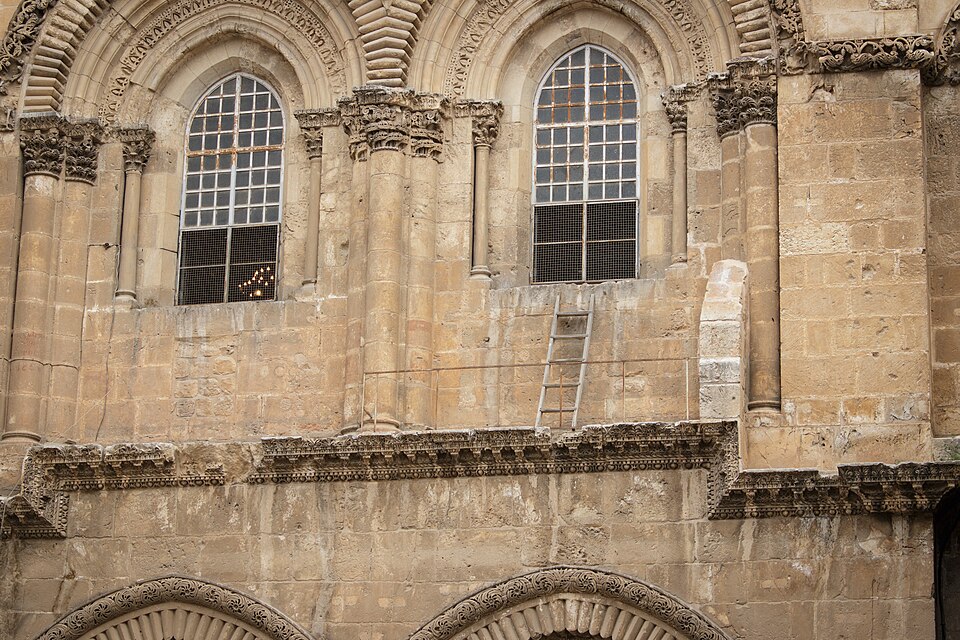
The wooden ladder positioned on the façade of the church has become one of the most recognisable symbols of the Status Quo. It appears in nineteenth-century images and has remained in approximately the same location for generations. It is widely known as the “immovable ladder,” although the popular narratives surrounding it sometimes simplify a more complicated history.
Uncertainty remains concerning the precise circumstances in which the ladder was placed there, its original practical function and the respective authority exercised over the window and ledge. Its significance, however, lies less in its material value than in what it represents. An ordinary object has acquired institutional meaning because moving it could be interpreted as altering an established arrangement or exercising disputed authority.
The ladder is often used to portray the Christian communities as incapable of overcoming trivial disagreements. Such an interpretation is tempting but incomplete. The object more accurately symbolises the difficulty of governing shared sacred space when possession is fragmented and no single authority is universally accepted.
A Muslim role at Christianity’s holiest church
The system surrounding the Holy Sepulchre also includes a remarkable Muslim role. For centuries, the responsibility for holding the key and participating in the opening and closing of the main entrance has been associated with the Joudeh and Nuseibeh families.
Different historical traditions provide varying explanations of how and when this arrangement originated. Its institutional purpose, however, is readily apparent. Muslim participation in the custody of the entrance prevents one Christian community from claiming exclusive control over the principal door.
The opening and closing of the church consequently represent an enduring example of practical interreligious accommodation. A Muslim custodian facilitates access to the place Christians venerate as the site of the Resurrection. The arrangement does not erase the religious differences among the communities involved. Instead, it transforms an external and comparatively neutral role into a mechanism for preserving equilibrium among competing Christian claims.
Religious autonomy and civil authority
The internal religious life of the Holy Sepulchre is governed by its recognised Christian communities according to the Status Quo. Israel, as the governing civil authority in Jerusalem, holds responsibility for public order, security, access and building safety.
Following the establishment of Israeli control over the Old City in 1967, the existing arrangements at the Christian holy places were maintained. The Holy Sepulchre was not transferred to a single Christian authority, nor was its internal system of possession and worship replaced. The Christian communities retained their traditional rights within the framework inherited from previous administrations.
The distinction between civil sovereignty and religious custodianship is important. Israeli jurisdiction over Jerusalem does not mean that the Israeli government controls the church’s theology, liturgy or internal allocation of sacred space. These matters remain primarily within the authority of the Christian custodial communities.
Public authorities nevertheless become involved when questions concern crowd management, security, emergency access, structural safety or disputes that affect the surrounding public realm. This relationship becomes particularly sensitive during major ceremonies attended by large numbers of worshippers. Decisions taken in the name of security may be perceived by church authorities as interference with religious freedom, while the state remains responsible for preventing overcrowding, disorder and threats to public safety.
The Holy Sepulchre therefore exists at the intersection of religious autonomy and civil responsibility. The boundary between them must continually be negotiated.
An institution of coexistence without consensus
Public accounts of the Holy Sepulchre often emphasise episodes of conflict among clergy. Such confrontations have occurred, and their visual character makes them attractive to international media. They reinforce the popular image of the Status Quo as an embarrassing manifestation of Christian division.
An exclusive concentration on conflict, however, overlooks the institution’s more substantial achievement. Six Christian communities, representing different theological, linguistic and historical traditions, continue to worship within the same building. They maintain distinctive identities without submitting to a unified hierarchy. The arrangement has endured through the collapse of the Ottoman Empire, the British Mandate, Jordanian administration, Israeli control, regional wars and profound political transformation.
The Status Quo is not an example of Christian unity in the theological or institutional sense. It is better understood as a form of coexistence without consensus. It enables communities to inhabit the same sacred environment while leaving fundamental disagreements unresolved.
Its rigidity can produce tension, delay conservation and perpetuate historical inequalities. Yet the same rigidity protects each community from unilateral encroachment by the others. For the smaller communities in particular, the principle that recognised rights cannot simply be altered may offer a measure of protection against more powerful institutions.
This constitutes the central paradox of the Holy Sepulchre. The framework that preserves division also makes continued coexistence possible.
Sacred space and institutional power
The Status Quo is more than an Ottoman administrative legacy. It remains a living system of governance. It distributes authority, regulates access, protects institutional identity and determines how sacred space is used. It establishes who may act, where action may occur and when change requires collective approval.
The arrangement also reveals that holy places cannot be understood solely through theology, archaeology or architecture. Sacred buildings are inhabited by communities whose identities depend upon memory, ritual and continued presence. Control over a chapel, procession or lamp may appear insignificant to an external observer, yet it can represent centuries of survival and recognition for the community concerned.
The Church of the Holy Sepulchre contains the places associated with the central events of Christian faith. At the same time, it embodies a complex history of institutional power. It demonstrates how religious communities protect their traditions, negotiate authority and remain together without dissolving their differences.
The Status Quo has not created harmony. Nor has it eliminated rivalry. It has created a framework through which disagreement can continue without allowing any single community to govern Christianity’s holiest church alone.
In Jerusalem, a city in which sacred space and political power have always been deeply connected, this may be one of the Status Quo’s most remarkable achievements.



Leave a Reply