

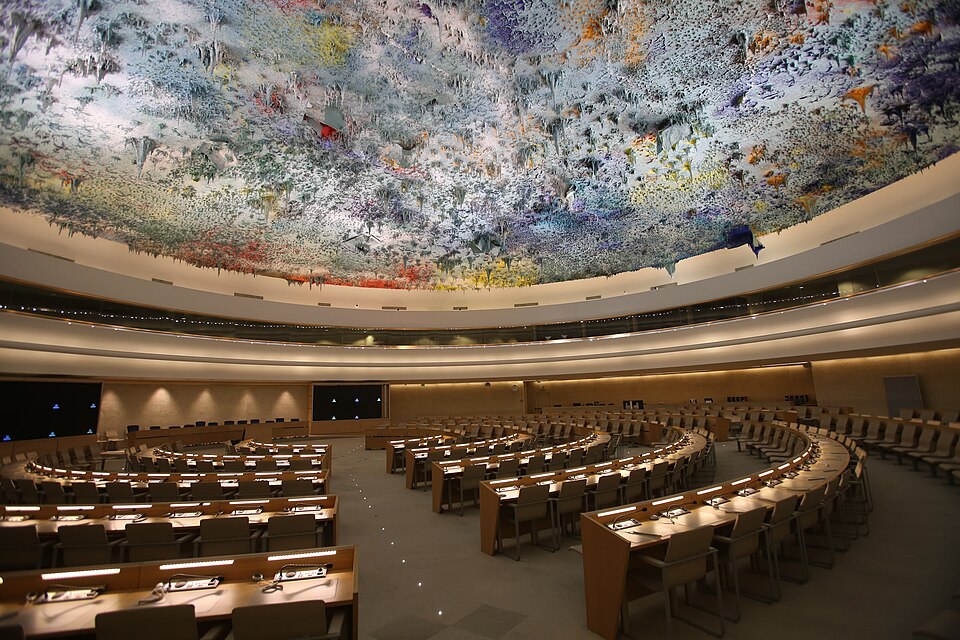
Featured image: Human Rights Council chamber, Palais des Nations, Geneva, 5 August 2015 (file photo). Photo: Ludovic Courtès / Wikimedia Commons, CC BY-SA 3.0. Resized. Thumbnail crops are also licensed under CC BY-SA 3.0.
The Jerusalem Institute of Justice’s new report challenges not merely the conclusions of the UN Commission of Inquiry, but the institutional structure, evidentiary standards and language behind them.
International investigations are expected to establish facts, identify responsibility and provide a measure of accountability when domestic mechanisms prove inadequate. Their legitimacy, however, depends upon one fundamental condition: the same standards must be applied to every party under investigation.
A new report published by the Jerusalem Institute of Justice raises the serious question of whether the United Nations Independent International Commission of Inquiry on the Occupied Palestinian Territory, including East Jerusalem, and Israel has satisfied that requirement.
Titled The Architecture of Bias, the 48-page report examines the Commission’s institutional design and its published work from its establishment in 2021 through May 2026. Its central allegation is not simply that the Commission has criticised Israel. Scrutiny of Israeli decisions and conduct is entirely legitimate. Rather, JIJ argues that Israel and Palestinian armed organisations — particularly Hamas — have been examined through different frameworks of responsibility, evidence and institutional attribution.
If that allegation is correct, the problem extends far beyond political disagreement with individual UN conclusions. It calls into question the credibility of the investigative mechanism itself.
An investigation without an end date
The Commission of Inquiry was established by the UN Human Rights Council in May 2021 through Resolution S-30/1. Its mandate encompasses alleged violations of international humanitarian and human-rights law, but also the “underlying root causes” of recurrent tensions and instability.
Unlike many fact-finding missions created to examine a defined event during a limited period, this Commission was established on a continuing basis. It has no predetermined conclusion date and reports repeatedly to both the Human Rights Council and the UN General Assembly. Its mandate therefore extends beyond investigating a particular war, military operation or episode of violence.
The Commission describes this breadth as necessary because individual outbreaks of violence cannot be understood independently from the conflict’s political and historical causes. The concern, however, is that an inquiry authorised to investigate undefined “root causes” indefinitely can evolve from a fact-finding mechanism into a permanent institution devoted to the scrutiny of one conflict—and, overwhelmingly, one UN member state.
This concern is not exclusive to Israel or Israeli organisations. In 2025, Australia, Canada, New Zealand, Norway and the United Kingdom jointly expressed regret over the Commission’s open-ended nature, describing it as inconsistent with standard practice while maintaining their support for proportionate scrutiny of violations by all parties.
The issue is not whether Israel should be investigated. It is whether a permanent investigative structure, created without a sunset clause or periodic renewal process, can preserve the appearance and practice of impartiality.
Responsibility described in different terms
One of the most consequential findings in JIJ’s report concerns the language through which responsibility is attributed.
According to the report, alleged Israeli violations are repeatedly connected to identifiable institutions: the Israeli government, named officials, military units, security forces, policies and expressions of institutional intent.
By contrast, Palestinian responsibility is more frequently distributed among general descriptions such as “armed groups,” “militants,” “attackers,” “Palestinian civilians” or members of various military wings. JIJ argues that this language gives considerably less attention to Hamas as a governing institution with a political leadership, military command, operational structures and established policies.
This distinction matters. International law does not assess only whether individual perpetrators committed particular acts. It also examines command structures, organisational policies, the knowledge and intention of leaders, and the relationship between political authority and operational conduct.
If Israeli actions are traced upwards through the chain of command while Hamas’s actions are primarily described through broad categories of perpetrators, the result is not equal accountability.
The Commission has not ignored Hamas’s responsibility. This point must be stated clearly. Its detailed investigation into the attacks of 7 October concluded that the assault was led and coordinated by Hamas’s military wing together with other Palestinian armed groups. It found that these organisations deliberately attacked civilians and committed war crimes, including murder, torture, cruel treatment, outrages upon personal dignity and hostage-taking.
The Commission’s 2024 report, A/HRC/56/26, therefore cannot reasonably be described as exonerating Hamas.
JIJ’s criticism is narrower and more significant: the Commission formally recognises Hamas’s crimes but does not subject its political leadership, governing structures, organisational policies and command responsibility to the same depth of institutional analysis applied to Israel.
Condemnation alone is not equivalent to investigation.

October 7 as a test of institutional impartiality
The Hamas-led attack of 7 October 2023 presented the Commission with an unavoidable test. The attack was not a spontaneous gathering of unrelated individuals. It involved planning, border breaches, coordinated assaults on multiple civilian communities and military locations, hostage-taking and the transportation of captives into Gaza.
The Commission documented grave crimes committed during the attack. Nevertheless, JIJ argues that its broader conclusions dispersed responsibility among Hamas’s military wing, other armed groups and participating civilians without examining the political leadership and organisational machinery behind the assault as rigorously as it subsequently examined Israel’s government and military institutions.
This creates a troubling analytical imbalance.
Israel is a state with ministries, publicly identifiable officials, military structures, written procedures and decisions exposed to intense international observation. Hamas is both an armed organisation and the governing power that controlled Gaza from 2007. The comparative opacity of Hamas cannot become a reason to examine its institutional responsibility less rigorously.
Non-state actors must not receive a lower level of scrutiny merely because their decision-making structures are less transparent than those of democratic states. Otherwise, transparency itself becomes a disadvantage: the actor whose institutions produce more public documentation becomes easier to investigate and therefore easier to condemn.
Are there also two standards of evidence?
JIJ further alleges that the Commission has applied different levels of evidentiary scrutiny.
According to its analysis, Israeli military and security explanations are frequently rejected when the Commission considers them insufficiently supported. At the same time, information originating from Palestinian authorities, advocacy organisations, confidential witnesses and social media is allegedly incorporated without the same visible discussion of corroboration, competing accounts or methodological limitations.
The Commission maintains that its findings are based on multiple forms of evidence, including interviews, written submissions, satellite imagery, medical records and verified open-source material. Israel, meanwhile, has refused to cooperate with the inquiry or provide its investigators with access, arguing that the Commission is structurally biased.
Israel’s non-cooperation creates a genuine methodological problem. A Commission denied direct access will inevitably rely more heavily on remote testimony, public material and third-party organisations. This limitation should be acknowledged rather than dismissed.
But restricted access does not resolve the central question. It may explain why certain sources were used; it does not establish that those sources were sufficiently tested or that comparable evidence from the opposing side was treated according to identical standards.
The appropriate question is not whether Palestinian sources should automatically be distrusted or Israeli explanations automatically accepted. It is whether provenance, corroboration, uncertainty and conflicting evidence are disclosed and evaluated consistently.
Can word counts demonstrate bias?
JIJ’s report also includes a lexical analysis of the Commission’s published reports. It identifies 1,557 references to “Israel” or “Israeli,” compared with 155 references to “Hamas.” It also records 803 references to “occupation” and “settlements,” 96 to “hostages” and six to “human shields.”
Numbers of mentions cannot, on their own, prove legal or political bias. A term may appear more frequently because of the subject, structure or evidentiary scope of a particular report. Quantitative findings require contextual interpretation.
Nevertheless, such a sustained disparity across the complete body of reports should not be dismissed as irrelevant. Combined with differences in institutional attribution and evidentiary treatment, the language may reveal which actors and legal concepts receive the Commission’s sustained analytical attention.
The most persuasive criticism is therefore not that Israel’s name appears too frequently. It is that the political and military architecture of Hamas may remain comparatively underexamined despite the organisation’s central role in governing Gaza, initiating the October 7 assault and embedding its military activities within a densely populated civilian environment.
The commissioners and the appearance of prejudgment
A fact-finding body must not only act impartially; it must inspire reasonable confidence in its impartiality.
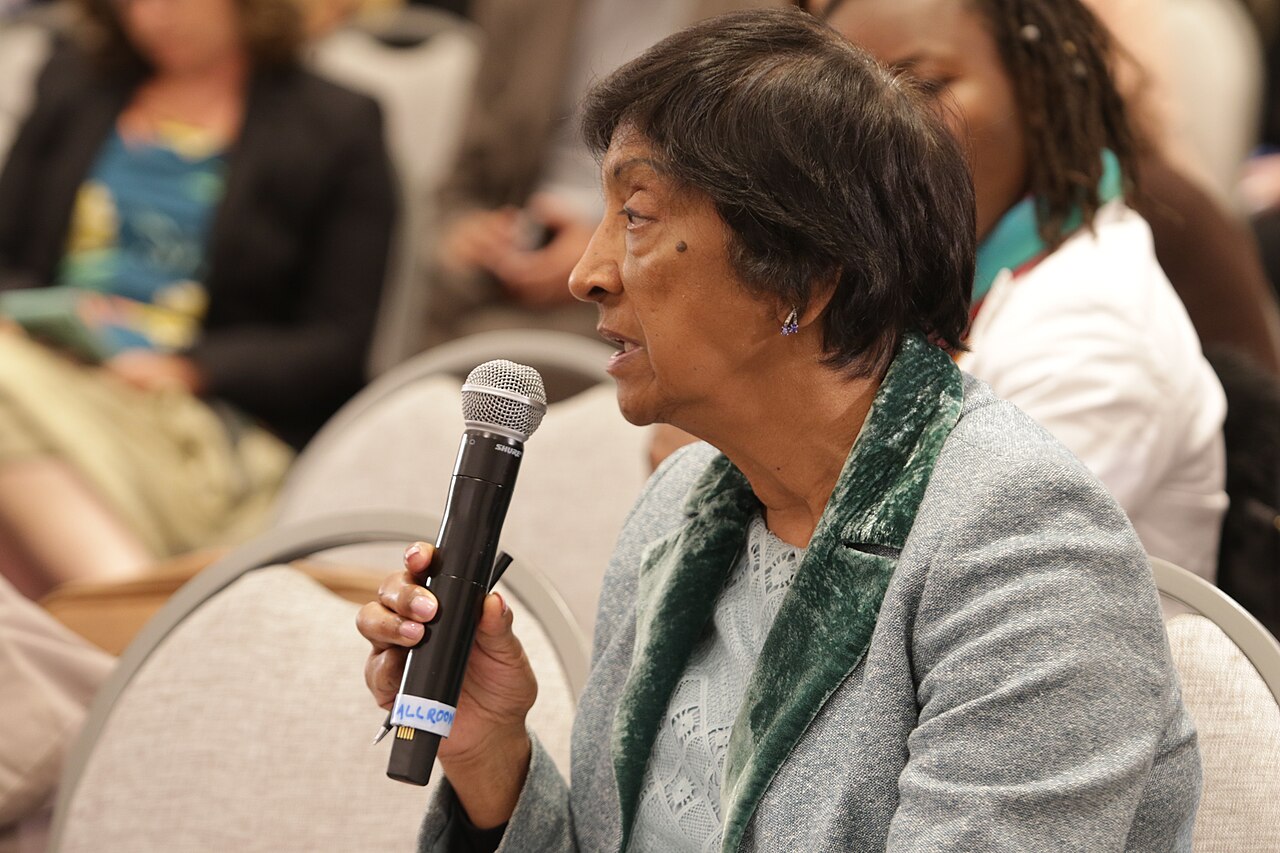
JIJ raises concerns about public positions associated with members of the Commission before or during their appointments. The report points, among other examples, to Chair Navi Pillay’s previous support for initiatives accusing Israel of apartheid and to comments by Commissioner Chris Sidoti dismissing some allegations of antisemitism as being thrown around “like rice at a wedding.”
Commissioners do not surrender their histories or opinions when accepting public appointments. Previous human-rights work does not automatically disqualify someone from investigating related matters. However, where prior statements appear to prejudge central questions later placed before the Commission, concerns about perceived impartiality become legitimate.
The standard cannot be whether a commissioner personally believes they can remain objective. The test must also consider whether a reasonable external observer could trust that the evidence will be approached without a predetermined conclusion.
Scrutiny is necessary — but it must be equal
None of these concerns means that Israel should be exempt from international law. Allegations of unlawful Israeli conduct must be investigated seriously. Civilian suffering does not become irrelevant because Israel faces a terrorist organisation, and the right of self-defence does not remove the obligations imposed by international humanitarian law.
But these principles must operate in both directions.
Hamas cannot be reduced to an abstract collection of “armed groups” when convenient and simultaneously treated as the governing and military authority of Gaza in other contexts. Its political leadership, command structures, operational planning, use of civilian environments and treatment of both Israelis and Palestinians require sustained institutional scrutiny.
International law loses credibility when its mechanisms appear to investigate democratic states with a level of precision they do not apply to authoritarian regimes and terrorist organisations.
This is why the debate surrounding the Commission should not be reduced to a contest between those who “support Israel” and those who “support human rights.” Israel’s supporters have every reason to demand credible investigations. International institutions influence diplomatic relations, sanctions, legal proceedings and public perceptions long after individual reports leave the news cycle.
As The Jerusalem Post reported, the Commission’s findings are not judicial verdicts. Nevertheless, its mandate to collect and preserve evidence and identify alleged perpetrators gives its conclusions considerable legal and diplomatic significance.
With that influence comes a corresponding obligation to demonstrate methodological transparency, institutional restraint and equal treatment.
The credibility of international law is also under investigation
JIJ has called upon UN member states to terminate the Commission’s current mandate and replace it with time-limited, event-specific investigations operating under clearer evidentiary and impartiality requirements.
Whether governments adopt that recommendation remains to be seen. But the underlying demand is reasonable: no international body should be considered beyond scrutiny merely because it operates under the banner of human rights.
The question is not whether Israel should face accountability. It should. The question is whether Israel is being judged according to standards that are applied with equal seriousness to Hamas and other Palestinian armed organisations.
A system that rigorously traces every Israeli decision to institutions, policies and named leaders — but treats the organisational responsibility of Hamas with less consistency — does not strengthen international law. It undermines confidence in it.
Impartiality cannot be established through declarations of neutrality. It must be visible in the mandate, the methodology, the treatment of evidence and the language through which responsibility is assigned.
When an institution investigates others, it must also be prepared to have its own standards investigated.



Leave a Reply