

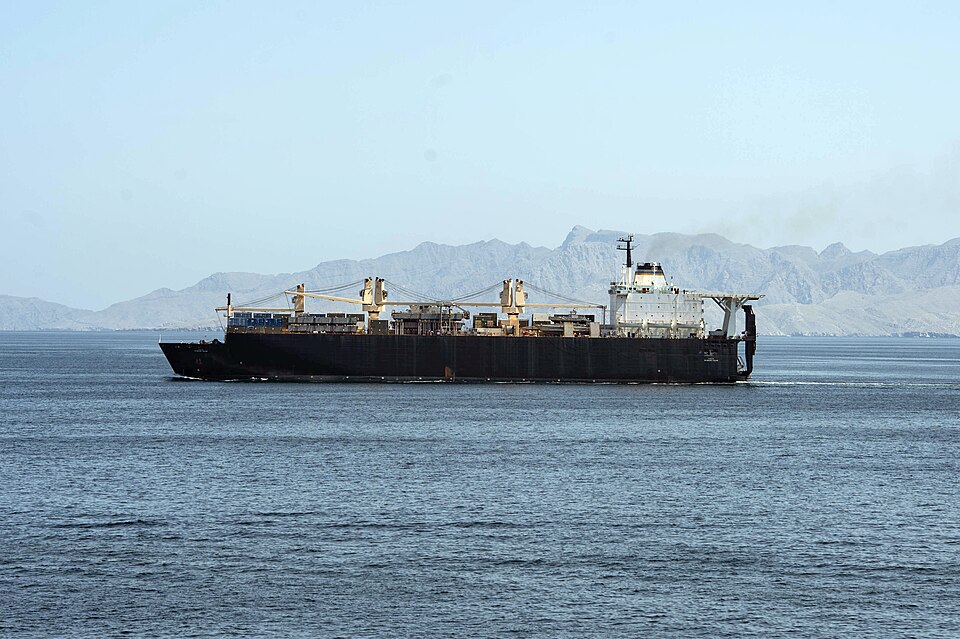
Featured image: Archival photograph: USNS PFC Dewayne T. Williams transits the Strait of Hormuz, 17 April 2020. Photo: Andrew Waters / U.S. Navy / Wikimedia Commons, Public domain. Resized.
The Strait of Hormuz and Bab el-Mandeb may appear to be distant maritime passages on the margins of the global political map. In reality, they are among the principal arteries of the international economy. When Iran and the Houthis threaten them, the consequences extend far beyond Israel and the Middle East, reaching energy markets, food prices, European households and the wider international order.
The geography of the Middle East has always shaped its political importance. The region contains not only significant oil and natural-gas reserves but also several of the maritime corridors through which global commerce must pass. Among them, the Strait of Hormuz and Bab el-Mandeb occupy a uniquely consequential position.
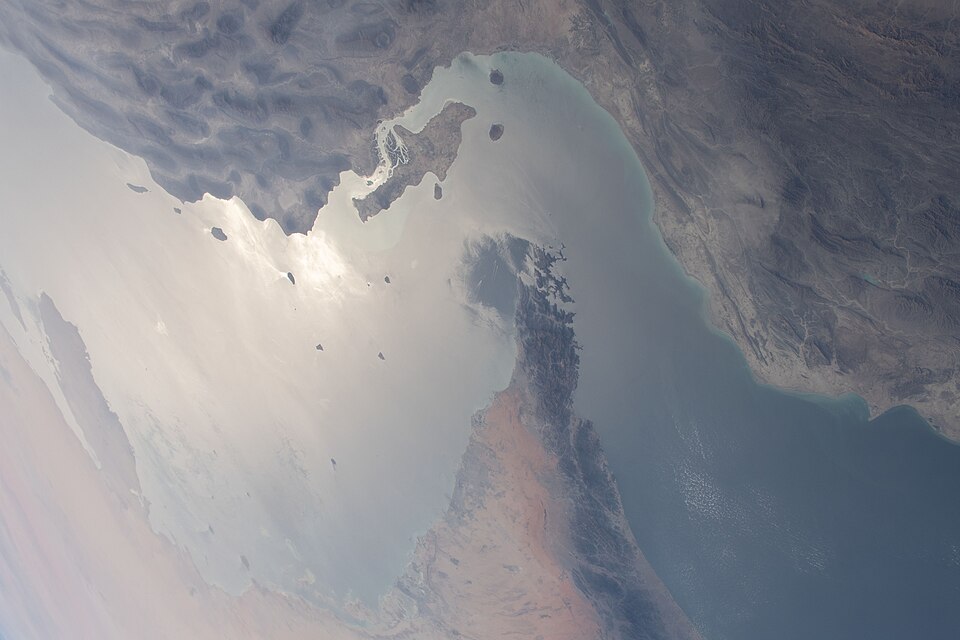
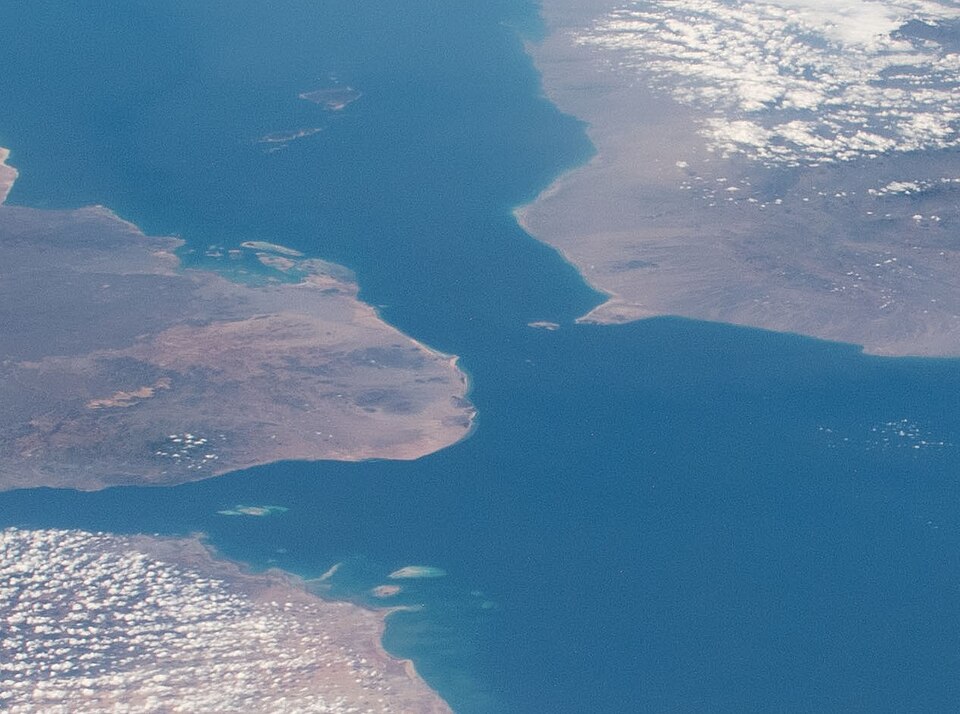
The Strait of Hormuz connects the Persian Gulf with the Gulf of Oman and the Arabian Sea. It provides the principal maritime outlet for the energy exports of Saudi Arabia, the United Arab Emirates, Qatar, Kuwait, Iraq and Iran. Bab el-Mandeb, situated between Yemen and the Horn of Africa, connects the Red Sea with the Gulf of Aden and, through the Suez Canal, the Mediterranean.
These two straits form part of an interdependent commercial system. Hormuz carries energy out of the Gulf, while Bab el-Mandeb connects Asian and Middle Eastern trade with Europe. Disruption at either location can raise prices and delay deliveries. Simultaneous disruption transforms a regional security crisis into a global economic emergency.
The importance of these waterways also explains why Iran and the Houthi movement in Yemen have invested heavily in their ability to threaten maritime traffic. Control does not require the permanent physical occupation of every shipping lane. It can be exercised indirectly through uncertainty. A limited number of missile attacks, drone strikes, vessel seizures or credible threats may be sufficient to persuade shipping companies, insurers and crews that navigation has become too dangerous.
The economic effect begins long before a strait is completely closed.
Hormuz and the World’s Energy Vulnerability
The Strait of Hormuz is narrow, but its importance is immense. Oil tankers transporting Gulf energy exports must navigate a restricted maritime corridor lying between Iran and Oman. Qatar’s liquefied natural-gas exports also depend heavily on this passage.
This concentration creates a structural vulnerability within the global economy. Governments may diversify their energy suppliers, maintain strategic reserves or develop alternative pipelines, but the volume of energy normally passing through Hormuz cannot be replaced rapidly or inexpensively.
Iran understands this vulnerability. Its ability to threaten shipping provides Tehran with a form of strategic leverage that exceeds the conventional size of its economy. Even when Iran cannot control international markets, it can influence the perception of risk surrounding one of their most important transport routes.
In the week between 28 September and 5 October 2026, maritime-security sources recorded at least twelve attacks on oil, liquefied-natural-gas and liquefied-petroleum-gas tankers around Hormuz. It was the highest weekly number reported since the present conflict with Iran began.
By 8 October, commodity-vessel traffic through the strait had fallen to its lowest level in more than two months. Crude movements were approximately 27 per cent below their wartime weekly peak and stood at around 74 per cent of pre-war levels. Alternative exports from the Gulf of Oman and the Red Sea compensated for part of the reduction, demonstrating considerable regional adaptability, but this adjustment did not remove the underlying risk.
Oil markets respond not only to the quantity of petroleum available but also to expectations about its future availability. A tanker attack that removes relatively little oil from the market can still produce a considerable price response if traders believe that the next incident may be more serious.
By 12 October, Brent crude remained above 100 dollars per barrel as markets continued to assess attacks on tankers, pressure on Gulf infrastructure and the uncertain possibility of renewed negotiations over Hormuz.
This uncertainty is itself an economic weapon. It increases the price paid by consumers without requiring Iran to maintain an absolute and permanent blockade. The threat of disruption may therefore generate economic pressure even when significant volumes of oil continue to reach international markets.
Bab el-Mandeb and the Expansion of Houthi Power
If Hormuz represents Iran’s direct leverage over maritime energy flows, Bab el-Mandeb demonstrates how Tehran can project influence through a regional partner.
The Houthis emerged from Yemen’s domestic political and religious landscape, and their development cannot be explained solely as an Iranian creation. Nevertheless, Iranian support has strengthened their military capabilities and connected their operations to a broader regional strategy.
The movement now possesses missiles, drones and other systems capable of threatening commercial vessels, ports, energy infrastructure and civilian airports. This has transformed the Houthis from a predominantly local insurgent force into an actor capable of disrupting international commerce.
Bab el-Mandeb is particularly vulnerable because it forms the southern entrance to the Red Sea. Vessels travelling between Asia and Europe normally pass through the strait before continuing towards the Suez Canal. When this route becomes dangerous, shipping companies must decide whether to accept the risk or divert vessels around the Cape of Good Hope.
The alternative route is possible, but it is neither quick nor free. Rerouting adds distance, fuel consumption, crew costs and additional pressure on the global availability of ships. It also produces delays that spread through supply chains far removed from the original conflict.
Recent fighting around Yemen’s Red Sea coast demonstrates that Bab el-Mandeb is no longer a peripheral element of the regional confrontation. In September 2026, the Houthis advanced along the coast and strengthened their position around the strait, prompting Saudi Arabia to support a counteroffensive. By early October, government forces had recovered some territory following Saudi airstrikes, but fighting continued.
The danger is not confined to ships. Houthi attacks on Riyadh’s international airport in October, followed by warnings directed at airlines, airport workers and passengers, demonstrated the group’s capacity and willingness to apply pressure against civilian transport infrastructure beyond Yemen.
This escalation carries particular significance for Saudi Arabia. The kingdom is attempting to diversify its economy, attract foreign investment and build an international tourism and business sector. Repeated attacks on airports, ports and energy infrastructure directly challenge that development strategy.
The conflict therefore concerns more than the movement of oil. It concerns whether non-state armed groups, supported by regional powers, can impose vetoes over commercial development and international transportation.
The Price of Avoiding the Straits
The existence of alternative routes is sometimes presented as evidence that global commerce can adjust easily to maritime disruption. This interpretation underestimates the cost of adaptation.
A vessel avoiding Bab el-Mandeb and the Suez Canal must sail around southern Africa. For tankers already struggling to avoid Hormuz, the combination of threatened routes can become particularly expensive.
Reuters calculated in July 2026 that rerouting certain oil voyages could extend a journey from approximately nineteen days to forty-eight days. Fuel costs for a single voyage could rise from around 1.26 million dollars to 2.87 million dollars, before additional fees and operational expenses were considered.
These figures matter because transport costs do not remain confined to shipping companies. They eventually appear in the price of fuel, manufactured goods, food, fertiliser and consumer products.
Insurance creates another layer of expense. When a maritime area is classified as a war-risk zone, ordinary coverage may no longer be sufficient. Shipowners must purchase additional protection, while crews may demand higher remuneration for entering dangerous waters. Some insurers may refuse to provide coverage entirely.
An executive from the Emirates National Oil Company stated in September that transit expenses through Hormuz had risen substantially, with war-risk premiums and cargo insurance forming a considerable share of the value of transported cargo.
The resulting price increases are not arbitrary charges imposed by the shipping industry. They reflect genuine exposure to vessel damage, environmental disaster, cargo loss, injury and death. Seafarers are among the most overlooked human participants in this crisis. They may come from India, the Philippines, Bangladesh or other countries with no political involvement in the conflict, yet they are expected to navigate waters threatened by missiles and drones.
Maritime coercion consequently transfers the risks created by regional actors onto international workers, businesses and consumers.
From Shipping Costs to Household Prices
The effects of maritime disruption move through the global economy in stages. The first impact is visible in oil and shipping markets. The second appears in industrial production and agriculture. The third reaches households through higher prices.
Oil is not used only to fuel private vehicles. It is embedded throughout modern economic activity. It powers ships, trucks, aircraft, construction equipment and agricultural machinery. Petroleum is also an input in plastics, chemicals and numerous manufactured products.
Natural gas is similarly important. It provides electricity, heating and industrial energy while also contributing to the production of fertiliser. When energy and fertiliser prices increase, food production becomes more expensive. When shipping is simultaneously disrupted, the cost of transporting that food also rises.
The countries most severely affected are not necessarily the wealthiest oil-importing states. High-income economies can use fiscal support, strategic reserves and monetary tools to manage part of the shock. Lower-income countries have fewer resources. A rise in fuel, grain or fertiliser prices can place direct pressure on public budgets and household survival.
UN Trade and Development has warned that conflict-related disruption produces a combination of higher energy, fertiliser and transport costs. These pressures are especially damaging for developing economies already facing debt burdens, currency weakness and food insecurity.
This is where maritime security becomes an international-development question. A missile launched towards a tanker in the Middle East may eventually affect the price of bread in North Africa, electricity in Europe or agricultural production in a low-income country. The causal chain may be complex, but it is real.
The burden is also regressive. Higher-income households can absorb an increase in transport and energy costs more easily than poorer families, for whom food, heating and mobility already consume a large share of monthly income. Regional aggression therefore creates economic consequences that fall disproportionately on those least able to bear them.
Europe’s Exposure
Europe is particularly vulnerable to disruption around Bab el-Mandeb because the Red Sea and Suez Canal constitute the shortest maritime connection between European markets and much of Asia.
When ships are diverted around the Cape of Good Hope, European companies wait longer for components, raw materials and finished products. The delay affects manufacturers that depend on precisely timed deliveries, retailers managing seasonal stock and consumers purchasing imported goods.
The energy effects are equally important. Higher oil and gas prices can produce renewed inflation just as European economies attempt to recover from previous energy shocks. Governments may then face pressure to subsidise households, while central banks confront the possibility that expensive energy will spread into wages and other prices.
This creates a policy dilemma. Raising interest rates may limit inflation, but it cannot reopen a maritime passage or prevent a drone strike. Excessively restrictive monetary policy may therefore weaken investment and employment without resolving the geopolitical source of the problem.
By October 2026, energy costs linked to continuing Middle Eastern conflict were again shaping expectations about inflation and interest rates across the United States and Europe. Markets were no longer treating instability as a temporary regional disturbance but as a factor with consequences for global monetary policy.
Europe’s dependence on secure maritime trade also exposes a broader contradiction. European political debates often treat Middle Eastern security as something external to the continent, while European economies remain deeply dependent on stability in the region.
Europe may be geographically separated from Hormuz and Bab el-Mandeb, but economically it is not distant at all.
Israel and the Maritime Front
For Israel, the security of these sea lanes is both a national and international concern. Houthi attacks have demonstrated that Israeli territory, maritime activity and commercial connections can be targeted as part of a wider Iranian strategy.
The objective is not necessarily to defeat Israel through conventional warfare. It is to surround the country with multiple sources of pressure, increase the cost of normal economic life and convince international businesses that engagement with Israel carries growing risk.
This strategy connects several theatres that are frequently analysed separately. Iranian pressure in Hormuz, Houthi operations near Bab el-Mandeb, Hezbollah’s military position in Lebanon and the activities of other armed groups are components of a regional system of coercion.
Recognising this network does not mean that every group is controlled in detail from Tehran or that each conflict has identical local causes. It means that Iran has developed relationships through which pressure can be applied across several geographic fronts while reducing the need for direct conventional confrontation.
Israel’s response must therefore include diplomatic and economic strategy alongside military defence. Maritime security cannot be guaranteed by Israel alone. It requires cooperation with the United States, European states, Gulf countries, Egypt and other governments dependent on freedom of navigation.
This creates an area of common interest that may remain important even when political disagreements over the Israeli-Palestinian conflict persist. Saudi Arabia, Egypt, the United Arab Emirates, Israel and European importers may differ on many political questions, but none benefits from allowing Iran or the Houthis to determine which civilian vessels may use international waterways.
Freedom of Navigation and the International Order
The attacks around Hormuz and Bab el-Mandeb raise a fundamental question about the meaning of international order.
Freedom of navigation cannot remain an abstract legal principle invoked only in diplomatic statements. It requires credible enforcement. If armed states or non-state groups discover that they can attack civilian shipping without facing sustained consequences, the model may be repeated elsewhere.
The danger extends beyond the Middle East. International trade depends on several narrow maritime passages, including the Strait of Malacca, the Bosporus and the Panama Canal. The global economy functions because governments and commercial operators assume that these routes will remain broadly accessible.
Permitting maritime coercion to become normal would encourage the transformation of strategic geography into political blackmail. States and armed movements controlling coastlines near major trade routes would gain an incentive to threaten global commerce in pursuit of regional objectives.
International responses must nevertheless be carefully designed. Military action may sometimes be necessary to protect vessels and deter attacks, but force alone cannot resolve the political fragmentation of Yemen or eliminate the wider Iranian strategy. Defensive operations should be accompanied by diplomatic pressure, sanctions enforcement, intelligence cooperation and efforts to disrupt the supply of weapons used against civilian transportation.
The international community must also avoid legitimising a dangerous distinction between supposedly acceptable and unacceptable vessels. A commercial ship does not become a lawful target because an armed organisation claims that its owner, destination or trading partner is politically objectionable.
Once non-state actors are allowed to decide which nationalities may participate in maritime commerce, freedom of navigation ceases to exist as a universal principle.
Two Straits, One Strategic Reality
Hormuz and Bab el-Mandeb are often discussed as separate security problems. The first is associated with Iran and Gulf energy exports, while the second is associated with Yemen, the Houthis and Red Sea shipping.
In economic and strategic terms, however, they form part of the same crisis. Pressure at Hormuz restricts the movement of energy from the Gulf. Pressure at Bab el-Mandeb obstructs the most efficient route connecting the Indian Ocean with the Mediterranean. When both are threatened, alternative routes become longer, more expensive and increasingly congested.
The international consequences reveal why developments in the Middle East cannot be dismissed as remote regional rivalries. Energy security, food affordability, inflation, industrial production and European economic stability are all connected to the security of these waterways.
Israel’s confrontation with Iran and its regional network must also be understood within this broader framework. The conflict is not solely about Israeli territory, nor is it confined to the future of Gaza or Lebanon. It concerns an attempt to use military pressure, proxy organisations and strategic geography to alter the regional balance of power.
The ships attacked in these waters may carry different flags. Their crews may come from countries with no role in the conflict. Their cargoes may be destined for Europe, Africa or Asia. Yet the risks imposed upon them originate in a regional strategy that treats civilian commerce as a legitimate instrument of political pressure.
The world therefore has a direct interest in resisting the normalisation of maritime coercion. Protecting Hormuz and Bab el-Mandeb is not an act undertaken exclusively on behalf of Israel, the Gulf states or Western governments. It is necessary for the functioning of an international economy upon which billions of people depend.
Two relatively narrow passages now expose a much wider truth: regional instability does not remain regional when it reaches the arteries of global trade.



Leave a Reply