

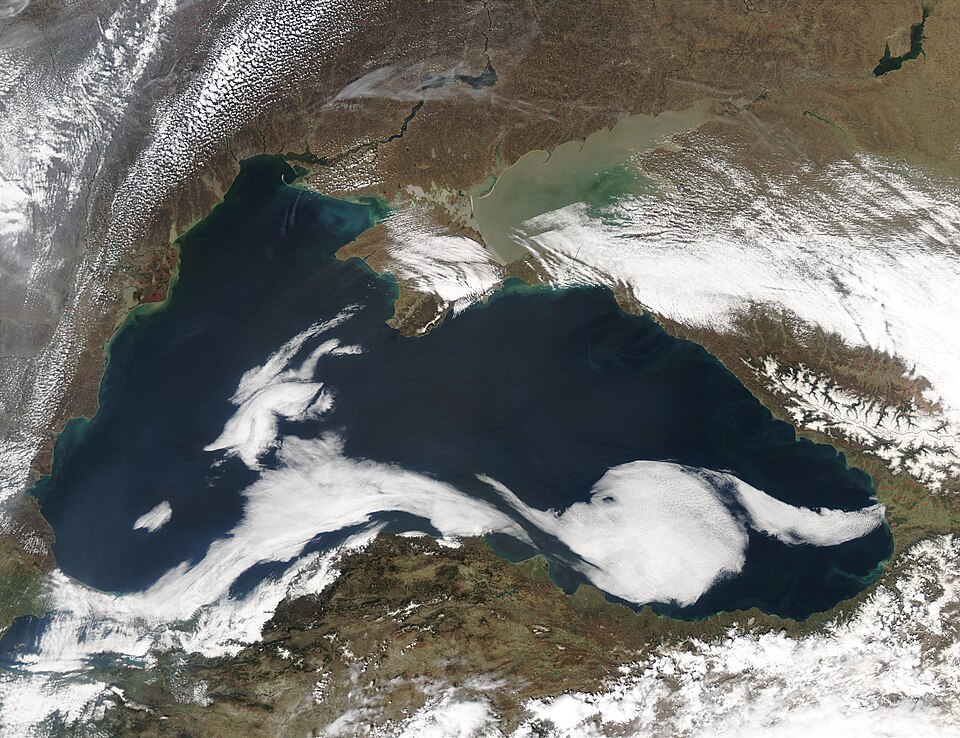
Featured image: the Black Sea and surrounding region, captured by Aqua/MODIS on 15 April 2003. Archival satellite image. Photo: Jeff Schmaltz, MODIS Rapid Response Team, NASA/GSFC / Wikimedia Commons, Public domain (NASA). Resized for web.
From Brussels and Washington to Moscow, Beijing and Ankara, the countries between the Baltic, the Balkans and the Black Sea have become the focus of a renewed contest for military access, infrastructure, political loyalty and economic influence. Romania stands at its centre — but strategic importance does not necessarily guarantee strategic power.
For much of the period following the Cold War, Eastern Europe was described as a region moving in one direction. Former communist states would join NATO, integrate into the European Union, liberalise their economies and gradually converge with the West. The process was presented as difficult but historically settled: the old divisions of Europe were disappearing, and the continent’s eastern half was returning to the political and cultural space from which Soviet domination had separated it.
That certainty no longer exists.
The situation between Russia and Ukraine has brought war back to Europe’s eastern frontier. NATO has reinforced its military presence from the Baltic Sea to the Black Sea. The European Union has revived an enlargement process that had previously lost credibility, while China has expanded its commercial and infrastructural presence, particularly in Serbia and the Western Balkans. Türkiye has developed its own combination of military, economic, diplomatic and cultural influence, and regional governments have learned to extract advantages by balancing between competing centres of power.
Eastern Europe is no longer merely completing its transition from communism. It is becoming the terrain of a new strategic contest.
Unlike the nineteenth-century “Great Game” between the British and Russian empires in Central Asia, this competition is not a simple confrontation between two powers. It operates through overlapping systems: American military protection, European funding and regulation, Chinese infrastructure, Russian energy and potential political disruption, Turkish regional diplomacy and the ambitions of local elites.
The battle is not only for territory. It is for ports, railways, energy networks, military bases, telecommunications systems, political loyalties and the authority to determine the region’s future.
At the centre of this map stands Romania: a NATO and EU member bordering Ukraine and Moldova, possessing access to the Black Sea and the Danube, hosting major Allied infrastructure and occupying a natural corridor between Central Europe, the Balkans and the former Soviet space. Yet Romania’s position also exposes a larger question confronting the entire region: are Eastern European states becoming independent strategic actors, or are they once again being valued primarily as territory through which stronger powers pursue their interests?
The Return of Europe’s Strategic Frontier
The countries of Eastern Europe have always lived closer to geopolitical risk than many of their Western neighbours. Their borders have repeatedly shifted, their sovereignty has often depended on the calculations of larger states, and their political development has been shaped by the collapse of empires, world wars, occupation and ideological division.
After 1989, NATO and EU enlargement appeared to offer an escape from this condition. Membership provided institutional security, access to Western markets and a political framework intended to prevent the region from once again becoming a buffer zone between rival powers.
The achievement should not be underestimated. For countries such as Romania, Poland, Bulgaria, Hungary, Croatia and the Baltic states, integration into Western institutions represented a decisive break with the insecurity of the twentieth century.
Nevertheless, membership did not eliminate geography. It reorganised it.
Russia’s annexation of Crimea in 2014, followed by the full-scale war with Ukraine in 2022, restored the military importance of Europe’s eastern frontier. NATO responded by reinforcing its presence, increasing readiness and developing its most extensive defence plans since the end of the Cold War. The Alliance now describes cyberattacks, sabotage, political interference, disinformation and airspace violations as part of a broader hostile campaign against its members and partners.
The Black Sea has consequently acquired a significance that Western governments had long underestimated. It is simultaneously a military theatre, an energy region, a commercial route and a strategic connection between Europe, the Caucasus and Central Asia. The Danube and the Port of Constanța have become essential to Ukrainian trade, while Romania and Bulgaria occupy increasingly important positions in NATO’s south-eastern defence architecture.
The Western Balkans present a different but equally sensitive landscape. Bosnia and Herzegovina remains constrained by internal constitutional conflict. Relations between Serbia and Kosovo remain unresolved, while Serbia continues to cultivate close relationships with Russia and China despite negotiating for EU membership. North Macedonia, Albania and Montenegro have moved closer to the Euro-Atlantic system, but political frustration and prolonged accession processes have left space for alternative influences.
What connects the Black Sea and Balkan theatres is a shared vulnerability: weak institutions, demographic decline, political polarisation, economic dependency and public distrust create openings that external powers can exploit.
Brussels: Enlargement as Geopolitical Strategy
The European Union remains the dominant economic and regulatory power across most of Eastern Europe. It is the principal trading partner, investor and provider of development funding for the Western Balkans, while its institutions shape legislation, infrastructure priorities and domestic reform programmes.
The EU’s influence is not imposed in the traditional imperial sense. Candidate governments actively seek access to its market, investment and political protection. For millions of citizens, European integration has represented freedom of movement, economic opportunity and a safeguard against authoritarianism.
Yet enlargement has increasingly become an instrument of geopolitical competition.
The European Commission’s 2026 enlargement package openly described expansion as an investment in the Union’s security, competitiveness and resilience. Albania, Montenegro, Moldova and Ukraine advanced through the accession process, while progress remained less consistent in Serbia, Bosnia and Herzegovina and Kosovo.
The return of enlargement reflects more than renewed idealism. Brussels understands that political vacuums in Eastern Europe will not remain empty. If the EU does not integrate the region, other actors will cultivate political, economic and security relationships of their own.
The Western Balkans Growth Plan, Moldova’s Growth Plan and the Ukraine Facility are designed to connect candidate states more closely to the European single market before formal membership. Energy, transport, payments, digital systems and defence cooperation are gradually being incorporated into European frameworks.
This can strengthen institutions and reduce dangerous dependencies. It can also create a form of integration in which candidate countries assume obligations before obtaining an equal voice in the decisions that govern them.
The difficulty lies in the asymmetry. In 2025, the EU accounted for more than half of the Western Balkans’ trade, while the entire region represented only a small fraction of total EU commerce. Candidate countries need Europe far more than Europe needs any one of them, even if Brussels increasingly needs the region as a whole for security reasons.
That imbalance allows the EU to demand reform and alignment, which may be justified when addressing corruption, organised crime or institutional abuse. But it also generates resentment when accession appears indefinitely postponed or when citizens conclude that their countries are being integrated economically without being accepted politically.
For existing members such as Romania, future enlargement presents another set of questions. The admission of Ukraine, Moldova and Western Balkan states could alter agricultural competition, labour mobility, cohesion funding and voting power inside the Union. These effects deserve scrutiny rather than being dismissed as hostility toward enlargement.
A larger Union may be strategically stronger, but only if expansion does not deepen inequality between its centre and periphery or require existing Eastern European members to absorb disproportionate costs.
Washington: The Provider of Hard Security
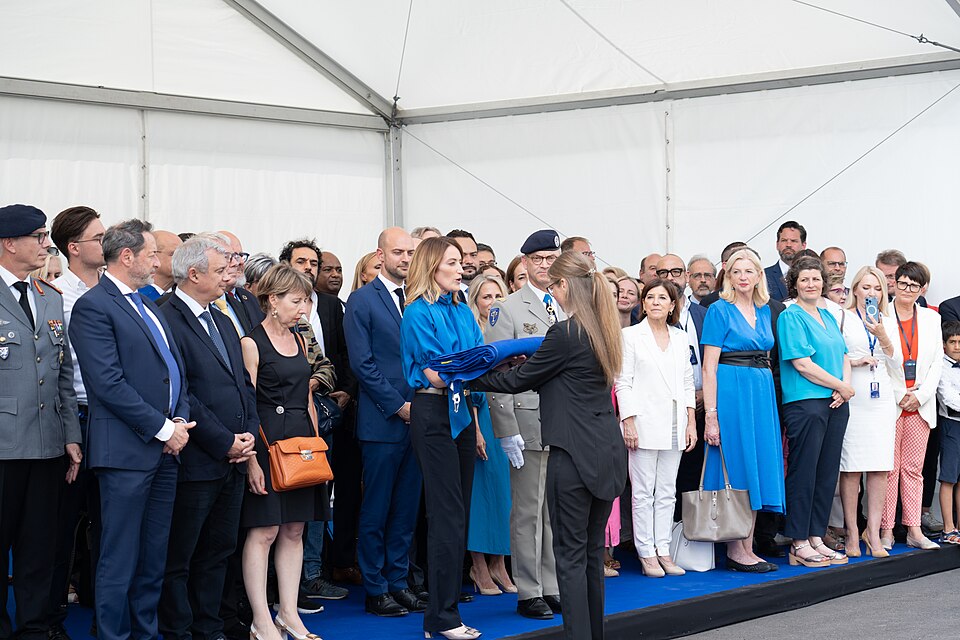
If Brussels dominates through markets and regulation, Washington remains the principal provider of military security.
NATO’s credibility depends heavily on American capabilities, intelligence, logistics and nuclear deterrence. This is particularly clear in countries closest to Russia or the war in Ukraine. Poland, Romania and the Baltic states regard the transatlantic relationship not as a diplomatic preference but as a fundamental guarantee of national survival.
American and Allied infrastructure across Eastern Europe has expanded accordingly. Romania hosts the Aegis Ashore missile-defence installation at Deveselu, Allied troops at Cincu, important command structures and an expanding military hub at Mihail Kogălniceanu. Its territory is central to NATO’s ability to reinforce the Black Sea region and protect the Alliance’s south-eastern flank.
This presence materially strengthens Romanian security. It also illustrates the difference between being strategically useful and exercising strategic influence.
A country may host bases, transit military forces and purchase advanced weapons while remaining peripheral to the decisions determining how those assets are used. Dependence on imported equipment can strengthen immediate defence while leaving domestic industry unable to maintain or replace critical systems during a prolonged crisis.
The same issue affects much of the region. Governments raise defence budgets and acquire Western technology, but investment in personnel, maintenance, ammunition, research and domestic production often remains inadequate. Military modernisation risks becoming an expensive purchasing programme rather than the construction of durable national capacity.
American protection is not inherently incompatible with European or regional autonomy. The problem arises when governments treat the alliance as a substitute for strategy. Reliable allies should contribute ideas, capabilities and industrial resources — not simply territory and procurement contracts.
Romania’s long-term objective should therefore be to remain firmly anchored in NATO while developing enough domestic capacity to influence the Alliance from within. Strategic loyalty has greater value when supported by bargaining power.
Moscow: Influence Through Disruption
Russia’s economic appeal across much of Eastern Europe has declined, particularly since the war with Ukraine. It cannot match the EU’s market, development funding or institutional attraction, nor can it offer the security provided by NATO.
Its remaining influence, however, should not be measured solely through trade.
Russian state institutions and aligned networks have sought to preserve influence through energy relationships, political contacts, media operations and intelligence activity, while exploiting existing divisions over history, national identity, religion and relations with the West. European and NATO assessments have documented information campaigns intended to deepen distrust, intensify polarisation and weaken confidence in democratic institutions, although much of the divisive content circulating in the region is also produced by domestic political actors.
Serbia remains Russia’s closest political partner in the Western Balkans, drawing on Orthodox and Slavic ties, opposition to Kosovo’s independence and resentment of NATO’s 1999 bombing campaign. Russian influence is also visible in the energy sector, including through gas supplies and ownership interests in strategic infrastructure.
Moldova’s relationship with Russia cannot be reduced to a story of foreign interference. For decades, Russia provided an important market for Moldovan goods, supplied much of the country’s energy and offered employment to large numbers of Moldovan citizens whose remittances supported families at home. Russian language, culture and family connections remain part of the social reality for many Moldovans, particularly outside the political circles oriented toward integration with the European Union. At the same time, the unresolved status of Transnistria and the continued presence of Russian military personnel and ammunition on Moldovan territory remain sources of dispute. Chișinău and its Western partners have accused Russian-linked actors of attempting to influence elections and public opinion, allegations Moscow rejects. Moldova is therefore not simply choosing between a helpful Europe and a hostile Russia; it is attempting to renegotiate a historically significant relationship that produced genuine benefits, substantial dependencies and unresolved security questions.
Across the wider region, European and NATO institutions have documented what they describe as Russian-linked disinformation, political interference and influence operations. These assessments deserve serious consideration, particularly where they identify traceable networks, coordinated campaigns or financial relationships. They should not, however, be treated as conclusive evidence in every individual case. Attribution in the digital information environment is often difficult, official reports may reflect the strategic perspectives of the institutions producing them, and some allegations remain contested or insufficiently demonstrated in public.
Nor should public scepticism toward the European Union, NATO or liberal political institutions automatically be classified as the product of Russian manipulation. Citizens may have legitimate reasons to distrust corrupt domestic elites, distant European authorities or economic policies that generated headline growth without providing security and opportunity for large sections of the population. Conservative views on national sovereignty, religion, identity or social policy can emerge organically from the region’s own history and should not be delegitimised simply because some of them coincide with positions promoted by Moscow.
External actors — including Russia, but not Russia alone—may seek to use existing grievances for strategic advantage. Yet those grievances are generally rooted in domestic experience: weak government, inequality, corruption, historical disputes and the failure of political institutions to maintain public trust. Assigning every social fracture to foreign interference risks allowing local governments to evade responsibility for problems they created or failed to resolve.
The appropriate response is therefore neither complacency about genuine interference nor the censorship of dissent under the broad label of disinformation. It is transparent investigation, evidence-based attribution, independent journalism and competent government. Claims of foreign interference should be supported by verifiable evidence and subjected to scrutiny, regardless of whether they are made by national governments, the European Union, NATO or any other institution. A politically informed society is best protected not by being told which opinions are permissible, but by having access to credible information and institutions worthy of its confidence.
Foreign powers rarely create a society’s deepest divisions from nothing; where interference occurs, it is usually most effective when domestic institutions have already allowed distrust and resentment to take root.
Beijing: Infrastructure, Technology and Access
Beijing generally avoids direct involvement in the region’s historical conflicts and presents itself as a pragmatic economic partner offering roads, railways, factories, mines and telecommunications infrastructure without the political conditions associated with European funding.
The centre of Chinese influence in the Balkans is Serbia. Chinese companies and banks have become involved in industrial plants, mining, transport infrastructure, surveillance technology and the modernisation of the Belgrade–Budapest railway.
European Parliament research indicates that China’s share of Western Balkan trade increased from 5.9 percent in 2019 to 9.5 percent in 2025. Serbia and Bosnia and Herzegovina have also developed substantial links with China’s Digital Silk Road, creating concerns about technological dependency and cybersecurity.
Chinese financing can be attractive to governments seeking rapid and highly visible development. Projects may be negotiated with fewer transparency requirements and less scrutiny of governance, labour conditions or environmental standards.
The apparent absence of political conditions, however, does not mean the absence of political consequences.
Large loans, state guarantees, opaque contracts and dependence on Chinese technology can generate long-term leverage. Infrastructure is never merely concrete and steel when it controls the movement of goods, information or energy. A railway, port, telecommunications network or surveillance system may serve commercial purposes while also embedding a foreign power within a country’s strategic architecture.
China does not need the Western Balkans to reject the European Union. It benefits if governments become sufficiently dependent on Chinese capital and technology to resist European decisions that conflict with Beijing’s interests.
This places Brussels in a difficult position. The EU remains by far the region’s dominant economic partner, but it has often failed to communicate its contribution effectively. Chinese projects may receive greater political attention because they are highly visible, negotiated directly and presented as evidence of decisive leadership.
Influence is not determined only by how much money is spent. It is also shaped by who receives the credit.
Ankara: The Regional Power Europe Misreads
Türkiye occupies a more complex position than either Russia or China. It is a NATO member, a Black Sea power, an EU candidate in name and an increasingly autonomous actor with its own regional ambitions.
Its influence in the Balkans is supported by geography, trade, historic connections and the presence of Muslim communities with cultural ties to the former Ottoman world. Ankara has invested in diplomatic relationships, transport links, restoration projects, educational and religious institutions, defence cooperation and commercial networks.
Turkish influence is sometimes exaggerated through simplistic warnings about “neo-Ottomanism.” Türkiye is not replacing the European Union as the Western Balkans’ dominant economic power, nor does every mosque renovation or cultural programme represent an imperial project.
Nevertheless, Ankara has developed something many Eastern European governments lack: an integrated understanding of national power.
It combines military capacity, arms exports, commercial aviation, cultural products, diplomacy and strategic geography. Its defence industry has become an increasingly important diplomatic instrument, while Turkish television and popular culture have created familiarity across the Balkans and beyond.
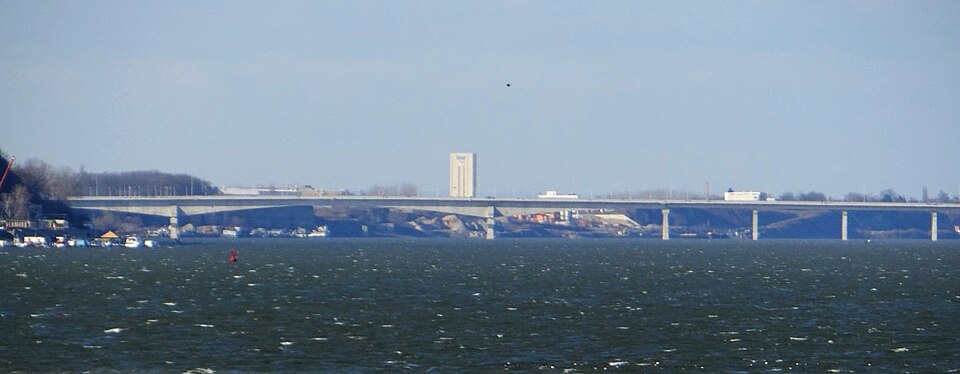
Türkiye is also indispensable to any serious Black Sea policy. It controls the maritime passage between the Black Sea and the Mediterranean under the Montreux Convention, maintains relations with both Russia and Ukraine, and seeks to preserve its freedom of action rather than simply following the preferences of its NATO partners.
For Romania, this creates both an opportunity and a constraint. Cooperation with Türkiye and Bulgaria is essential for maritime security, demining and the protection of critical infrastructure. Yet Bucharest must recognise that Ankara approaches the Black Sea through its own national interests, not through a permanently shared regional vision.
Romania should do the same.
The Local Elites Who Invite Foreign Power
External influence is often discussed as though it were imposed on passive societies. In reality, foreign powers frequently enter through doors opened by local political elites.
Governments seek outside investment to finance projects they can display before elections. Political parties cultivate external relationships that increase their international legitimacy. Leaders describe themselves to Washington as guarantors of security, to Brussels as indispensable reformers, to Beijing as trusted commercial partners and, where politically useful, to Moscow as defenders of sovereignty and tradition.
These relationships can benefit citizens. They can also help entrenched elites avoid accountability.
A government that controls the media, weakens independent institutions or distributes public contracts through patronage may still receive external support if it remains useful to a larger strategic objective. Western governments have sometimes tolerated democratic backsliding in exchange for stability, migration control or foreign-policy alignment. China generally asks few questions about domestic governance, while Russia actively benefits from institutional weakness and political division.
This is why the contest for Eastern Europe cannot be understood simply as a competition between benevolent and malign powers. Every external actor pursues interests, even when those interests also produce genuine benefits for the region.
The decisive variable is domestic institutional strength. Transparent governments can negotiate foreign partnerships while protecting national interests. Corrupt or captured governments convert strategic assets into instruments of political survival.
Eastern Europe’s vulnerability is therefore not caused only by its geography. It is also created by the weakness of the institutions responsible for governing that geography.
The Demographic Weakness Beneath the Strategic Map
The region’s growing geopolitical importance conceals a profound internal crisis: it is losing people.
Eurostat estimates that between 2005 and 2025 Romania’s population declined by approximately 11 percent, while Bulgaria lost around 16 percent and Croatia about 10 percent. The Western Balkans face similar pressures from low fertility, ageing and the continued emigration of younger and highly skilled citizens.
This demographic decline affects every dimension of power. It reduces the workforce, weakens tax systems, increases pressure on pensions and healthcare, deprives the military of recruits and leaves smaller communities without essential professionals.
It also changes the balance between the region and the external powers competing within it. Countries that cannot retain their own citizens become increasingly dependent on foreign capital, imported labour, remittances and security guarantees.
The contradiction is striking. Eastern Europe has become more strategically important to larger powers at precisely the moment when many of its own societies are becoming less capable of sustaining themselves.
Military bases and transport corridors may increase a country’s geopolitical value, but they cannot compensate for disappearing communities, failing schools and the continuous export of educated young people. A region cannot build genuine sovereignty if its most ambitious citizens believe their future lies elsewhere.
Romania: Leader, Shield or Transit Corridor?
Romania occupies an advantageous but exposed position within this new competition.
It is the largest EU and NATO state on the Black Sea’s western coast, controls the principal European access route to the Danube Delta, borders both Ukraine and Moldova and possesses ports, energy resources and military infrastructure of growing importance.
Its economic relationship with the European Union is overwhelming, while the United States remains central to its defence. It must cooperate with Türkiye in the Black Sea, manage the consequences of the war in Ukraine and respond to instability and political competition in Moldova. Developments in Serbia and the Western Balkans affect regional transport, security and European integration.
Romania should therefore be capable of exercising considerable influence. Yet it has frequently behaved as a policy-taker: reliable in fulfilling Allied expectations, supportive of European initiatives and willing to assume regional responsibilities, but hesitant to formulate conditions of its own.
The danger is that Romania becomes simultaneously a military platform, an energy connection and a transport corridor without capturing sufficient political or economic value from any of those roles.
Foreign forces may operate from Romanian territory, Ukrainian goods may transit Romanian infrastructure, Moldova may depend on Romanian energy support, and European strategies may describe Romania as essential — yet Romanian communities can still remain disconnected from modern transport, healthcare and economic opportunity.
A serious national strategy would insist that external commitments contribute directly to domestic capacity. Military spending should strengthen Romanian industry and technological expertise. Port and railway investments should serve Romanian commerce as well as regional transit. Energy interconnections should improve national resilience before becoming instruments of permanent subsidy. Support for neighbouring states should be conditional, transparent and demonstrably connected to Romanian security.
Romania should remain firmly anchored in the West, but belonging to the West should not require the suspension of national interest. Mature alliances are built on reciprocity, not obedience.
Sovereignty in an Age of Interdependence
No state in Eastern Europe can isolate itself from the systems surrounding it. The region’s economies depend on trade and investment, its security depends heavily on alliances, and its infrastructure increasingly crosses national borders.
Sovereignty therefore cannot mean economic autarky or equal distance from every major power. Nor should it become a slogan used by politicians to conceal corruption or dismantle institutional constraints.
In contemporary Europe, sovereignty means possessing enough capacity to enter partnerships without becoming subordinate to them. It requires governments that understand the difference between foreign investment and strategic dependency, between military protection and political passivity, and between European integration and the abandonment of national responsibility.
Eastern European countries should scrutinise foreign control over critical infrastructure, demand transparency in large investment agreements and rebuild domestic defence and industrial capacity. They should cooperate regionally where interests genuinely coincide while resisting arrangements that transfer risks and costs onto their citizens without reciprocal benefit.
Most importantly, they must strengthen the institutions through which national interests are defined. Without competent administrations, independent oversight and informed public debate, the region will continue to be governed through decisions made between political elites and external patrons.
The Difference Between Choosing the West and Having a Voice Within It
The new competition for Eastern Europe does not recreate the Cold War exactly. Most EU and NATO members in the region have made a clear strategic choice, and the societies seeking accession overwhelmingly understand the economic and security advantages of joining Western institutions.
The unresolved question is what position they will occupy within that order.
The region can remain a frontier protected, financed and occasionally disciplined by larger powers. It can offer military bases, labour, raw materials, transit routes and political loyalty while major strategic decisions are formulated elsewhere.
Alternatively, its states can begin to convert geography into negotiating power, investment into domestic capacity and alliance membership into genuine influence.
Romania is particularly well placed to make that transition. It possesses the territory, population, resources and institutional memberships required to become a serious Black Sea and south-eastern European actor. What it has often lacked is the political confidence and strategic continuity to act accordingly.
The future of Eastern Europe will not be decided simply by whether Brussels defeats Moscow, Washington contains Beijing or Türkiye expands its regional reach. It will depend on whether the countries caught between these powers can define and defend their own interests.
The new Great Game is already under way. The decisive question is whether Eastern Europe will remain the board on which others play — or finally become a player in its own right.
Sources and Further Reading
- European Commission, 2026 Communication on EU Enlargement Policy, 4 November 2026.
- European Commission, 2026 Enlargement Package Shows That Reform Commitment Delivers Progress Towards EU Membership, 4 November 2026.
- European Parliamentary Research Service, Paving the Way to EU Enlargement: Assessing Economic Trends and Future Prospects, 2026.
- European Parliamentary Research Service, Paving the Way to EU Enlargement: Assessing Potential Implications on Security and Defence, 2026.
- European Parliamentary Research Service, EU Energy Relations with the Western Balkans, 2025.
- European Parliament, Chinese Investments in European Non-Maritime Transport Infrastructure, 2023.
- European Centre of Excellence for Countering Hybrid Threats, Western Balkans: Domestic, Regional and International Trends Creating Hybrid-Threat Potential, 2026.
- NATO, Strengthening NATO’s Eastern Flank, updated 2026.
- NATO, Allies and Partners Meet in Bucharest to Strengthen the Response to Russia’s Hybrid Activities, 19 October 2026.
- Eurostat, Demography of Europe: 2026 Edition.
- World Bank, Europe and Central Asia Economic Update, Autumn 2025.
- Prague Process, Western Balkans 2035: Demographic Resilience and Strategic Migration Planning, 2026.
- European Council on Foreign Relations, An Outsider Within: The Paradox of the Europe–Türkiye Relationship, 2026.
- European Council on Foreign Relations, From Myth to Reality: How to Understand Türkiye’s Role in the Western Balkans.



Leave a Reply