

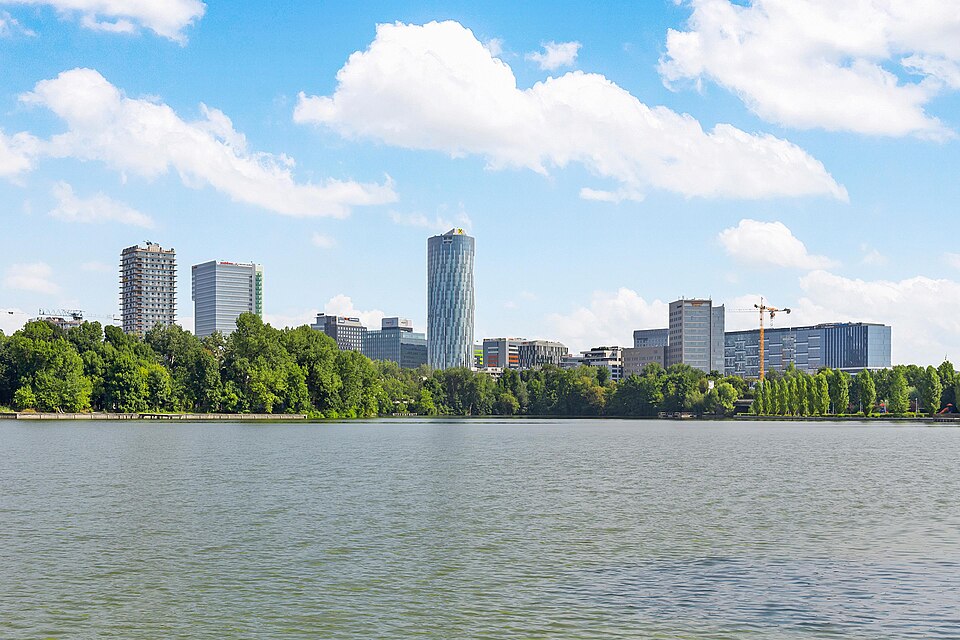
Featured image: Bucharest’s Floreasca business district, April 2024. Archival photograph. Photo: Madalin Pentelie / Wikimedia Commons, CC0 1.0. Resized for web.
Romania’s economic convergence with Western Europe is undeniable. Yet national averages conceal a widening internal divide between prosperous metropolitan centres and communities losing people, services and any realistic expectation of recovery.
From the business districts of Bucharest, Romania can appear to be one of the European Union’s most convincing economic success stories. Glass office towers dominate the northern skyline, multinational companies compete for qualified employees, private hospitals and international schools continue to expand, and residential developments promise a standard of living increasingly comparable to that of Western European capitals.
The transformation is not confined to Bucharest. Cluj-Napoca, Timișoara, Iași, Brașov, Sibiu and Oradea have attracted investment, developed technology and service sectors, modernised public spaces and created opportunities that would have been difficult to imagine three decades ago.
This progress is genuine. Since joining the European Union in 2007, Romania has experienced substantial economic convergence, benefited from foreign investment and gained access to unprecedented levels of European funding. Yet the national story becomes considerably more complicated once one leaves the major metropolitan centres.
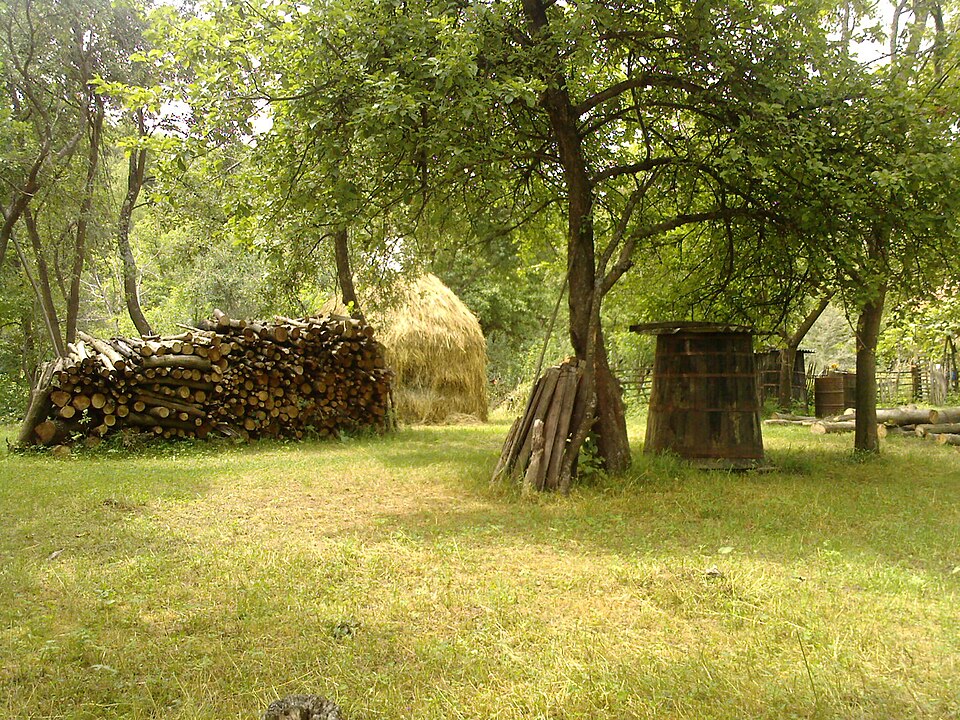
Across large parts of the country, particularly in the south, east and rural interior, development has followed a very different trajectory. Communities are ageing and losing working-age residents. Schools are closing or operating with declining numbers of pupils. Medical services are increasingly concentrated in distant urban centres. Public transport is inadequate or non-existent, while many households still lack access to infrastructure that should no longer be regarded as a privilege in an EU member state.
Romania is not simply developing at different speeds. It is producing increasingly different experiences of citizenship, determined to an alarming degree by geography.
The Misleading Comfort of the National Average
Romania’s economic achievements are usually presented through national indicators: growth, household consumption, wage increases, investment and GDP per capita measured against the European average. These figures are important, but they combine profoundly unequal regional realities into a single national picture.
Bucharest-Ilfov has become one of the most economically successful capital regions in Central and Eastern Europe. According to the OECD, its GDP per capita is more than twice that recorded in every other Romanian region and almost four times that of the North-East. The organisation also found little evidence that this disparity was narrowing. Between 2015 and 2021, Bucharest-Ilfov remained the country’s fastest-growing regional economy, while several of Romania’s poorest regions recorded little real economic growth. www.oecd.org
Eurostat has similarly identified Romania as one of the EU countries with the greatest internal variation in GDP per inhabitant. Its measure of regional economic disparity was exceptionally high in 2022 and had increased compared with 2012, even as the country continued to converge with the EU as a whole. ec.europa.eu
This reveals the central contradiction of Romania’s development model. The country has moved closer to Western Europe, but its poorest regions have not necessarily moved closer to Bucharest. Economic convergence at European level has therefore coexisted with persistent — and in some respects widening — divergence at home.
The prosperity of the capital raises the national average, but it tells us little about whether a village in Vaslui has a family doctor, whether a child in Teleorman can reach a well-equipped school or whether a household in rural Dolj is connected to a functioning sewerage system. National indicators can measure the size of an economy; they are less effective at showing how opportunity is distributed within it.
Poverty Is Concentrated, Not Random
The scale of Romania’s territorial inequality becomes even clearer when economic output is compared with poverty.
In 2024, Bucharest-Ilfov recorded an at-risk-of-poverty rate of just 3.7 percent — the lowest of any region in the European Union. ec.europa.eu Viewed in isolation, this is an impressive result. Set against conditions elsewhere in Romania, however, it demonstrates how misleading the national portrait can be.
The OECD has documented poverty rates exceeding 30 percent in some of Romania’s poorest regions. It also found that Romania had the largest rural–urban poverty gap in the European Union: in 2022, the income-poverty rate was approximately 34 percent in rural areas, compared with 6 percent in cities. www.oecd.org
Such differences cannot credibly be explained by individual behaviour alone. They reflect the cumulative effects of unequal infrastructure, limited labour markets, weak public services, lower administrative capacity and decades of migration.
A child born in a disadvantaged rural locality does not begin life with access to the same institutional support as a child born in Bucharest. Although both are Romanian citizens and formally possess the same rights, their practical access to education, healthcare, transport, digital infrastructure and professional networks may be radically different.
The World Bank illustrated this disparity through a comparison between Bucharest-Ilfov and neighbouring Giurgiu. Its Human Capital Index estimated a substantial gap in the productive potential of children born in the two areas, despite Giurgiu directly bordering the capital region. documents1.worldbank.org
The boundary between prosperous and disadvantaged Romania is therefore not found only in distant or isolated regions. In some cases, it begins immediately beyond Bucharest’s metropolitan perimeter.
How Infrastructure Shapes Opportunity
Regional inequality is often described through the technical language of productivity, labour participation, investment absorption and competitiveness. For residents of underdeveloped communities, however, it is experienced in far more immediate terms: an unsafe road, an absent bus service, a distant hospital, an understaffed school or a household still dependent on a well and improvised sanitation.
The World Bank reported that, as of 2020, public water systems served almost the entire urban population but only 39 percent of rural residents. The proportion of rural inhabitants connected to wastewater infrastructure was just 15 percent. It also found that unmet medical needs were higher in rural areas than in Romanian cities and significantly above the EU average. documents1.worldbank.org
Although some of these indicators will have improved as new projects have been completed, they reveal the scale of the structural deficit Romania continues to confront. Infrastructure that should have been developed systematically over several generations is still being delivered unevenly, often after the communities intended to benefit from it have already lost a large proportion of their younger population.
This creates a cycle that is difficult to reverse. A locality with inadequate services loses families and working-age residents. Their departure reduces school enrolment, weakens the local labour market and shrinks the municipal tax base. Businesses become less inclined to invest, while public authorities find major projects increasingly difficult to justify on the grounds of population size.
Decline is then presented as proof that the community is no longer viable, rather than as the foreseeable consequence of years of underinvestment. What began as institutional neglect is gradually reclassified as demographic inevitability.
Education and the Inheritance of Inequality
The territorial divide begins long before young Romanians enter the labour market.
Children in prosperous urban areas are more likely to have access to well-resourced schools, private tutoring, language courses, digital equipment and a broad range of extracurricular opportunities. In many rural communities, schools struggle to recruit qualified teachers, maintain facilities and provide specialist support. Some pupils travel considerable distances each day, while others are taught in environments where declining enrolment makes long-term planning increasingly difficult.
Formally, they participate in the same national education system. In practice, the system prepares them for very different futures.
Public discussion often attributes poor educational outcomes to families, accusing parents of indifference or communities of resisting progress. This explanation ignores the conditions in which many families are expected to function. Parents may have limited education themselves, work abroad or depend on precarious employment. Children may be raised primarily by grandparents, while private tutoring — now an informal extension of Romanian schooling — remains beyond the financial reach of poorer households.
When talented young people from these communities reach university, they usually move to Bucharest or another major city. Many do not return, because the professional opportunities available at home are too limited. Their decision is entirely rational at the individual level, but its cumulative effect is damaging: the communities that most need doctors, teachers, entrepreneurs and competent administrators continually lose the people capable of filling those roles.
Education should be Romania’s principal mechanism of social mobility. Instead, it frequently reproduces the territorial inequalities children inherit at birth.
Healthcare Determined by Postcode
A similar divide exists in healthcare. Romania has highly trained doctors and increasingly sophisticated private and public medical facilities, but those resources are heavily concentrated in large urban centres.
Bucharest, Cluj-Napoca, Timișoara, Iași and several other cities offer specialist treatment, advanced equipment and extensive private alternatives. Smaller towns and rural communities often depend on ageing family doctors, inadequately staffed hospitals and unreliable transport to regional medical centres.
For patients with sufficient income, this problem can be overcome through mobility. They travel to a university city, pay for private consultations or seek treatment abroad. Those without comparable resources may postpone care until a manageable condition becomes an emergency.
The division is therefore not simply between insured and uninsured citizens. It is also between those who can convert a formal entitlement into effective medical care and those for whom healthcare remains geographically, financially or practically inaccessible.
Equal rights on paper do not guarantee equal outcomes when the institutions responsible for delivering those rights are distributed so unevenly.
Beyond a Simple Bucharest–Countryside Divide
It would be a mistake to blame Bucharest for its own success. Romania requires a competitive capital capable of attracting investment, retaining skilled workers and operating within international economic networks. Nor should the country’s development be reduced to a simplistic conflict between Bucharest and the provinces.
Several secondary cities have built strong regional economies and become important centres of innovation, education and employment. Their success demonstrates that growth does not have to remain confined to the capital.
Nevertheless, some of these cities are beginning to reproduce the same unequal relationship with their surrounding territories. The metropolitan centre attracts young residents, businesses and public resources, while nearby towns and villages lose population and struggle to maintain essential services. Property values and wages rise within the urban core without necessarily generating sustainable development across the wider region.
Romania’s economic geography increasingly resembles a series of prosperous metropolitan islands connected to European markets but insufficiently integrated with their own hinterlands. The principal divide is therefore not exclusively between urban and rural Romania, but between places connected to investment, mobility and institutional capacity and those progressively excluded from all three.
European Funds and the Capacity Paradox
European funding has transformed Romania’s physical landscape. Roads, water networks, schools, hospitals, public spaces and local businesses have all benefited from EU programmes. Without these funds, many essential projects would either have been delayed substantially or never undertaken at all.
Yet the ability to obtain and manage European funding is itself distributed unequally.
Large municipalities can employ specialised teams, commission feasibility studies and hire experienced consultants. Small communes — often those with the greatest infrastructure needs — may depend on a limited number of officials already responsible for a wide range of administrative duties. They are expected to compete for complex funding programmes without possessing comparable institutional capacity.
The OECD has noted that county and local governments account for more than half of Romania’s public investment, while many smaller municipalities continue to face significant capacity constraints. www.oecd.org
This produces a damaging paradox: administrative capacity attracts investment, but sustained investment is often required to develop administrative capacity in the first place. Communities that are already better governed and better connected are consequently more capable of obtaining new resources, while disadvantaged localities risk falling further behind.
The political emphasis on absorption rates can also conceal the difference between spending money and producing lasting transformation. A renovated public building may improve local conditions, but it does not automatically generate employment. A new road can connect a community to economic opportunity, but it can also facilitate faster departure if no local opportunities exist. A project may be completed successfully from an accounting perspective while having little effect on demographic or economic decline.
Romania should therefore assess European funding not only by the value of contracts signed or money spent, but by whether communities become more viable after the funding period has ended.
The Political Incentives Behind Unequal Development
Territorial inequality also reflects the way political priorities are established.
Governments and local authorities naturally favour projects that can be announced, photographed and completed within an electoral cycle. Large construction projects produce visible evidence of activity. Long-term investments in preventive healthcare, teacher retention, regional transport coordination or administrative reform are less dramatic and may take years to produce measurable results.
Political influence also affects which communities succeed in placing their needs on the national agenda. County capitals and well-connected municipalities can lobby ministries, prepare stronger applications and attract media attention. Small, declining communities possess far less influence. As they lose population, they also lose electoral weight, making it easier for successive governments to postpone difficult interventions.
The result is a reinforcing cycle in which communities lose residents, political relevance and public services, each loss accelerating the next.
Over time, this deterioration becomes normalised. A school closure is described as a rational response to demographic decline. The absence of a doctor is treated as a labour-market shortage. A cancelled transport route becomes an efficiency measure. Each decision may appear defensible when considered separately, but their combined effect can amount to the gradual withdrawal of the state from entire territories.
When Regional Inequality Becomes a Democratic Risk
The consequences extend beyond economics. Citizens who experience the state primarily through inadequate services, unfulfilled promises and administrative distance are unlikely to be persuaded by official narratives of national success.
When political leaders celebrate growth while daily life is characterised by depopulation and declining services, public optimism can begin to resemble propaganda. This disconnect creates favourable conditions for radical parties, anti-system candidates and conspiratorial narratives.
Disinformation is particularly effective when it attaches itself to legitimate grievances. Citizens may be misled about who is responsible for their circumstances, but the underlying experience of abandonment is not imaginary. Governments cannot answer such discontent solely through fact-checking initiatives or warnings about extremism.
Democratic trust must be supported by material evidence that the state is present and citizenship retains practical meaning. A functioning school, a family doctor, a reliable train and access to clean water are not merely public services; they are part of the infrastructure through which democratic legitimacy is sustained.
If parts of the population conclude that established institutions neither see them nor serve them, electoral anger should not come as a surprise.
A Different Model of Regional Development
Romania does not need to weaken Bucharest or its successful regional cities in order to support poorer areas. It does, however, need to abandon the assumption that metropolitan prosperity will eventually spread without deliberate intervention.
A credible regional strategy would improve transport between smaller communities and economic centres, provide long-term incentives for medical and educational professionals to work in underserved areas, and strengthen the administrative capacity of poorer local authorities. It would also connect smaller towns to regional supply chains rather than expecting each locality to attract major investors independently.
Not every declining village can be restored to its former population, and not every locality can maintain every public service. Promising to revive the entire countryside would be as misleading as claiming that its decline is unavoidable. Yet there is a substantial difference between managing demographic change responsibly and allowing communities to deteriorate through neglect.
Services can be organised regionally without becoming inaccessible. School consolidation can be accompanied by safe and dependable transport. Telemedicine and mobile clinics can supplement medical provision without being presented as substitutes for doctors. Infrastructure planning can help communities adapt while preserving a reasonable standard of life.
Above all, territorial inequality must no longer be treated as a peripheral social concern. It is simultaneously a development challenge, a demographic crisis, an economic-security issue and an emerging threat to democratic stability.
The True Measure of Convergence
The divide between Romania’s metropolitan success stories and its disadvantaged regions was not created by one government or one political party. It is the result of decades of centralisation, uneven investment, deindustrialisation, weak administration, migration and short-term political planning.
No single funding programme will close it. Nevertheless, the process must begin with an honest description of the country as it exists. Romania cannot continue to use Bucharest’s prosperity as evidence that national development has reached everyone. Nor should convergence with Western Europe be celebrated without examining the distances that persist within Romania itself.
The ultimate measure of development is not whether the capital resembles other European capitals. It is whether a child’s prospects remain radically dependent on the county, town or village in which that child is born. Romania’s two realities are already visible: one is connected to investment, institutions and mobility, while the other is increasingly expected to survive through remittances, family support, improvisation and departure.
The political question is whether Romania can reconnect these realities before the distance between them becomes permanent.
Sources and Further Reading
- European Commission, 2026 Country Report: Romania, 3 June 2026. economy-finance.ec.europa.eu
- OECD, Economic Surveys: Romania 2026. www.oecd.org
- OECD, Reviews of Labour Market and Social Policies: Romania 2025. www.oecd.org
- OECD, Enhancing Strategic Planning and Innovation Services: Romania. www.oecd.org
- World Bank, Romania Systematic Country Diagnostic Update: A Tale of Two Romanias. documents1.worldbank.org
- Eurostat, Regional Yearbook 2024. ec.europa.eu
- Eurostat, People at Risk of Poverty by EU Region, 2024. ec.europa.eu



Leave a Reply