


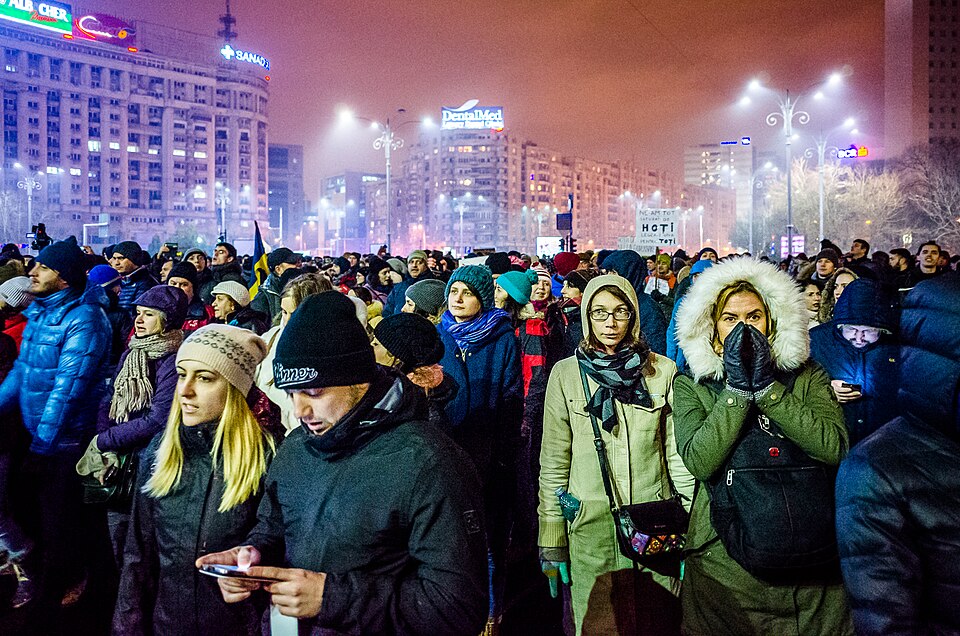
Featured image: The Palace of Justice in Bucharest, 2016. Archival image. Photo: Ștefan Jurcă / Wikimedia Commons, CC BY 2.0. Resized.
The Accountability Vacuum Between Elections
Democracy is not exhausted by the act of voting. Elections determine who receives authority. They do not give governments, parliaments, regulatory bodies or judicial institutions the right to exercise that authority without explanation.
Yet in Romania, citizens are frequently informed about decisions only after the essential choices have already been made. Laws appear through emergency procedures. Appointments are announced without a transparent account of how candidates were evaluated. Public consultations take place after institutions have effectively settled their position. Requests for information encounter delays, formalistic replies or institutional silence.
The result is a political system that remains democratic in its constitutional structure but often communicates with the public as though explanation were optional.
This article is not another examination of Romania’s cancelled 2024 presidential election. That episode deserves its own scrutiny and is already addressed elsewhere on Raw Truth Media. The problem considered here is broader and more persistent: what happens between elections, when institutions make decisions affecting millions of people but citizens cannot clearly reconstruct who decided, on what evidence, after which consultation and with what responsibility for the outcome?
When institutions stop explaining themselves, formal authority remains visible. Accountability does not.
Romania Does Not Lack Transparency Laws
Romania’s problem is not the complete absence of legal rules.
Law No. 544/2001 provides access to information of public interest. Law No. 52/2003 requires transparency in public decision-making. Draft legislation should ordinarily be published, citizens and organisations should have opportunities to submit observations, and public authorities are expected to explain the reasoning and likely consequences of proposed measures.
More recent reforms have introduced regulatory-impact assessments, consultation platforms, lobbying rules, integrity declarations and open-government commitments. So on paper, the architecture exists.
The OECD’s 2026 assessment found that Romania fulfilled 67% of the evaluated criteria concerning access-to-information regulations and 62% of the criteria concerning their implementation in practice. These figures place Romania close to the OECD average in practical implementation. The country proactively publishes important categories of information, including government-session agendas and minutes, public procurement data, legislation and declarations of assets and interests. oecd.org
That progress should be recognised.
But the same assessment identified an important institutional weakness: Romania has no independent supervisory body empowered to inspect public authorities and sanction them for non-compliance with access-to-information rules. Ministers’ agendas are also not consistently disclosed.
Citizens may possess a legal right to request information, but the system lacks a strong central mechanism capable of enforcing that right across public institutions. A right without effective enforcement can become an administrative negotiation.
Governing Through Emergency
One of the clearest examples of Romania’s accountability problem is the repeated use of government emergency ordinances.
The Constitution permits emergency ordinances in exceptional circumstances. The instrument exists because genuine crises sometimes require immediate action. However, when exceptional procedures become a routine method of government, the distinction between urgency and political convenience begins to disappear.
Emergency legislation compresses the time available for parliamentary scrutiny, expert assessment, media examination and public participation. Complex changes can enter into force before affected groups have properly understood them.
The European Commission’s 2026 Rule of Law Report acknowledged that Romania adopted fewer emergency ordinances in 2025 than in 2024. Nevertheless, it concluded that shortcomings remained and again recommended reducing their frequent use while ensuring effective consultation before legislation is adopted. PDF)
The Council of Europe’s anti-corruption body, GRECO, reached a similarly troubling conclusion. It found that government emergency ordinances had not been subjected to an adequate level of public consultation and considered its recommendation concerning this issue unimplemented. ROMANIA
The concern is not merely procedural. Legislation determines taxes, pensions, public-sector salaries, energy rules, education, healthcare, business obligations and the distribution of public resources. When such measures are repeatedly adopted under accelerated procedures, those affected are expected to obey rules they had little meaningful opportunity to examine or challenge. Urgency then becomes more than a legislative mechanism. It becomes a governing culture.
Consultation or Administrative Theatre?
Public consultation is not meaningful simply because a document appears on a ministry website. For participation to matter, citizens and professional organisations need sufficient time to analyse proposals, access the evidence supporting them and understand how their submissions affected the final decision.
Romanian law generally provides only a short minimum period for submitting observations. The OECD reported that the minimum period remained ten days and found that the quality of explanatory notes and impact assessments varied considerably across the administration. Institutional capacity to conduct serious regulatory-impact analysis also remained limited. OECD
Ten days may be technically sufficient to register a response. It is often inadequate for universities, business associations, unions, civil-society organisations or local authorities to evaluate complex legislation and consult those they represent.
A deeper problem concerns what happens after submissions are received. Citizens may send proposals without receiving a substantive explanation of why those proposals were accepted or rejected. Institutions can therefore claim that consultation occurred while preserving nearly complete control over the outcome.
GRECO has recommended that Romania publish a genuine legislative footprint: a record identifying substantive external contributions, the parties involved and the reasons those contributions were accepted or refused. ROMANIA
That would transform consultation from a ceremonial stage into an auditable process. Transparency should not mean merely allowing citizens to speak. It should require institutions to demonstrate that they listened.
Parliament Must Scrutinise, Not Merely Process
Parliament is supposed to provide democratic scrutiny over executive power. Committees should examine legislation, hear specialists, question ministers, consider amendments and make political responsibility visible.
But parliamentary accountability weakens when urgent procedures are used too broadly, committee deliberations remain difficult to reconstruct or important amendments appear late in the legislative process.
GRECO’s parliamentary review found that Romania had made progress on several integrity recommendations. Eight of thirteen recommendations had been implemented satisfactorily, and new lobbying rules represented a significant improvement.
Nevertheless, three recommendations remained unimplemented. GRECO reported no progress on establishing criteria for closed committee meetings or ensuring that urgent legislative procedures are used only as exceptions. It also found that measures concerning parliamentary integrity training had not yet fully materialised and that robust safeguards regarding gifts, hospitality and other benefits remained incomplete. rm.coe.int
Romania’s institutions are not standing still. Reforms have occurred. But partial reform can coexist with persistent opacity, particularly when legislation moves quickly and political majorities treat scrutiny as an obstacle rather than a democratic obligation.
A governing coalition has the right to enact its programme. It does not have the right to reduce Parliament to a transmission mechanism for decisions prepared elsewhere.
Who Influences the Decision?
Public institutions rarely make policy in isolation. Businesses, professional associations, trade unions, NGOs, consultants, international institutions and informal political networks all attempt to influence public decisions. Lobbying is not inherently corrupt. Decision-makers need information from affected sectors.
The danger arises when influence remains invisible. Romania strengthened its framework in 2025 by regulating lobbying and requiring parliamentarians to register meetings with third parties concerning legislative initiatives. The OECD found Romania above its comparative average on several lobbying criteria, while the European Commission considered the relevant recommendation fully implemented. oecd.org
But a register is useful only when it enables the public to answer practical questions:
- Who sought to influence a law?
- Whom did they meet?
- What position did they advocate?
- Did their proposal appear in the final text?
- Was contrary expertise considered?
- Who ultimately assumed responsibility for the decision?
The objective is not to criminalise contact between public officials and private actors. It is to prevent influence from operating more effectively in private than public participation operates in the open.
Appointments Without Persuasive Explanations
Institutions derive legitimacy not only from their legal powers but also from the credibility of the people appointed to lead them.
Senior prosecutors, regulators, public-company directors, ministerial advisers and members of oversight bodies may exercise considerable authority without being directly elected. The appointment process therefore needs transparent criteria, evidence of competence and publicly intelligible reasoning.
Romania has introduced measures allowing integrity checks for certain top executive positions. Rules governing conflicts of interest, revolving doors and asset declarations have also developed.
Yet important weaknesses remain. The European Commission reported in July 2026 that no legislative progress had been made on strengthening safeguards for the independence of high-ranking prosecutors or the organisation and operation of the judicial police. It also noted concerns about transparency in certain judicial promotions and senior appointments. PDF)
The same report found that, in January 2026, approximately 430 of 657 judicial management positions — around 65% — were occupied through delegation rather than permanent appointment. Magistrates’ associations and civil-society organisations argued that such extensive reliance on temporary delegation could affect institutional independence. PDF)
Temporary appointments may sometimes be necessary. But when provisional arrangements become systemic, authority can become dependent on those who renew, terminate or control the delegation. The public should not be required to trust an appointment merely because an institution declares it lawful. Legality is the minimum threshold. Legitimacy also requires an explanation of why one person was selected, according to which criteria and through what competitive process.
Institutional Independence Cannot Mean Institutional Silence
Independent institutions must be protected from political interference. Courts, prosecutors, central banks, electoral authorities and regulators cannot perform their functions if governments can dictate every decision. But independence should never be confused with immunity from explanation.
An independent institution must still:
- publish the legal basis for its decisions;
- disclose the evidence it can lawfully make public;
- explain its methodology;
- distinguish proven facts from assessments or assumptions;
- respond to legitimate criticism;
- correct errors;
- provide meaningful avenues for review.
The 2026 Rule of Law Report noted that only 41% of the Romanian public and 43% of companies considered judicial independence “fairly or very good.” Perceptions are not proof that particular decisions were improper, but they reveal a serious credibility problem. PDF)
Institutions cannot repair such distrust by demanding confidence. They must earn it through consistent procedures and reasoned decisions.
Authority says: “We have the legal competence to decide.” Accountability adds: “This is what we decided, this is the evidence we considered, this is the law we applied, and this is how the decision can be challenged.” Romania too often provides the first statement without adequately providing the second.

Opacity Creates the Conditions for Disinformation
Institutions frequently complain that citizens are vulnerable to manipulation, conspiracy theories and false information. That concern is real. Disinformation can damage democratic debate and exploit legitimate grievances.
But institutions also need to recognise their own contribution to the information vacuum. When authorities release conclusions without underlying evidence, use abstract language, delay requested information or dismiss questions as politically motivated, speculation becomes predictable. People begin filling evidentiary gaps with rumours, partisan interpretations and fragments of information circulated online.
Transparency does not eliminate propaganda. But opacity makes propaganda easier.
A democratic state cannot credibly demand that citizens trust official information while withholding enough information for those citizens to evaluate official claims. The answer to public distrust is not increasingly aggressive communication management. It is verifiable institutional behaviour.
Accountability Is Not Anti-State
Demanding explanations from institutions is sometimes portrayed as an attack on the state, the judiciary, European commitments or democratic stability. The opposite is true.
Institutions become stronger when their decisions can survive scrutiny. Public officials gain legitimacy when they explain the constraints under which they acted. Courts earn confidence through consistent legal reasoning. Governments improve policy when consultation exposes unintended consequences. Parliament fulfils its constitutional role when debate is substantive rather than ceremonial.
Accountability does not mean that every citizen must approve every decision.
It means citizens should be able to understand:
- who possessed the authority;
- what evidence was used;
- which interests were consulted;
- what alternatives were considered;
- how the final decision was justified;
- who bears responsibility if the policy fails.
Without these elements, public power becomes visible only through its consequences.
What Romania Should Change
Romania does not require another transparency strategy that exists mainly as a document. It needs enforceable institutional practices.
The country should:
- establish an independent body capable of monitoring and sanctioning violations of access-to-information obligations;
- treat government emergency ordinances as genuinely exceptional;
- extend consultation periods for complex legislation;
- publish complete regulatory-impact assessments before adoption;
- create a legislative footprint recording external proposals and institutional responses;
- publish ministers’ agendas and meetings with organised interests;
- make parliamentary committee activity easier to examine;
- justify urgent legislative procedures individually;
- publish clear criteria and reasoned decisions for senior public appointments;
- reduce excessive reliance on temporary delegations;
- provide accessible explanations alongside highly technical institutional decisions;
- measure transparency by the usefulness of disclosed information, not merely by the number of uploaded documents.
These reforms would not prevent disagreement. They would allow disagreement to occur on the basis of evidence rather than institutional mystery.
The Right to an Explanation
Romania’s accountability deficit is not created by one party, one government or one institution. It is a governing habit inherited and reproduced across political cycles.
Power is often treated as something won through elections and then exercised internally until the next election. Citizens are invited to choose their representatives but are given limited ability to trace the decisions made in their name between those moments.
That is not sufficient for a mature democracy. Voting grants temporary authority. It does not cancel the citizen’s right to understand how that authority is used.
Romania does not need institutions that explain themselves only when scandal, litigation or international pressure makes silence impossible. It needs institutions that regard public reasoning as part of their ordinary constitutional duty.
So, “Can those who govern demonstrate, in public and with evidence, why they exercised power as they did?”
When institutions can no longer answer that question persuasively, the problem is greater than poor communication. It is a failure of accountability.
Sources and Further Reading
2. OECD, Anti-Corruption and Integrity Outlook 2026: Romania.
3. OECD, Better Regulation Practices Across the European Union 2025: Romania.
4. Council of Europe, GRECO, Fifth Evaluation Round Compliance Report on Romania, adopted June 2025.
6. Romania, Law No. 544/2001 on Free Access to Information of Public Interest.
7. Romania, Law No. 52/2003 on Transparency in Public Decision-Making.



Leave a Reply