
TL;DR: Despite renewed chatter and behind-the-scenes lobbying, Romania has no legal path to restart gold mining at Roșia Montană right now. The UNESCO designation still stands, the exploitation license has expired and was not renewed, and the investor lost the flagship arbitration in 2024 (though appeals and local court challenges continue). The only visible “moves” are administrative (urban plan, site management, custody of underground works) and litigation—not a reopening.
The new signal from the top
On 18 August 2025, during a visit to Roșia Montană, President Nicușor Dan said plainly that mining is excluded with today’s technology—adding that only radically different future methods could change that calculus. Multiple outlets carried the same quote; it wasn’t a trial balloon.
That doesn’t end the story—but it sets the tone. Politically, there’s no green light to mine now. Diplomatically and legally, the brakes were already on.
Why the pressure never really dies: the size of the prize
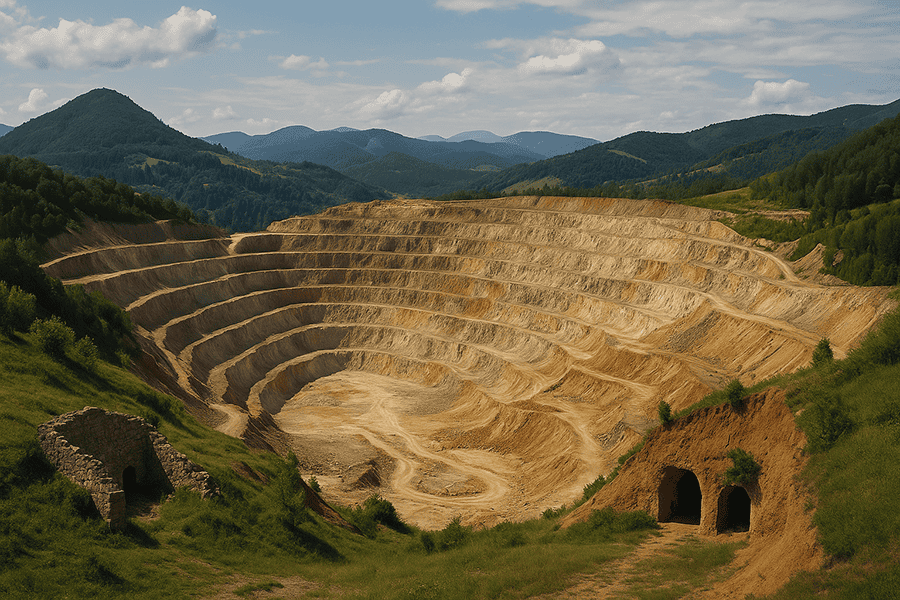
Roșia Montană is one of Europe’s largest undeveloped gold deposits. Conservative, company-reported proven & probable reserves: ~10.1 million ounces of gold (≈314 tonnes) plus ~47.6 Moz silver. Broader estimates cited by global media place remaining reserves around 314 tonnes of gold and ~1,500 tonnes of silver. That’s why the site keeps attracting “attention”—public and private.
The hard stops in 2025 (and why a quick “re-exploitation” is fantasy)
1. UNESCO status is active—and stricter than ever.
Roșia Montană remains on the List of World Heritage in Danger. Any development in or around the property requires Heritage Impact Assessments (HIA) before permits. The World Heritage Committee’s 2025 decision again retained the site on the Danger List and reminded Romania that HIAs are a pre-requisite for any project.
2.The exploitation license expired—and wasn’t renewed.
UNESCO notes the license automatically terminated on 20 June 2024 after the mining agency refused extension; the company has challenged the refusal in Romanian court (pending). Independent reporting the same week confirmed the non-renewal
3. Arbitration momentum is gone.
On 8 March 2024, Romania won the headline ICSID case; the investor has filed an annulment/stay pathway, but that doesn’t reinstate permits or override UNESCO. Bottom line: the legal leverage that once fueled pressure on Bucharest has ebbed.
4. Planning and management now run through heritage.
UNESCO records show Romania is finalizing a new General Urban Plan (PUG) and a revised Management Plan for the site—both to be reviewed in heritage terms before adoption. There’s even a move to transfer control of underground mine workings from the company to the state—so archaeologists can plan proper research. These are conservation-first steps, not mining preparation.
Translation: Without a valid license, without heritage clearance (HIA), and with the UNESCO regime in force, no authority can lawfully green-light a Roșia Montană mine in 2025.
“Shadow work” vs. public record: what’s actually moving?
Let’s separate rumor from documentation:
- Litigation and appeals: The company is contesting the license non-renewal in Romanian courts and has pursued annulment/stay avenues around the ICSID award. These are on the record.
- Administrative housekeeping: State-led PUG/Management Plan work and potential custody transfer of underground workings to a state agency are logged in UNESCO decisions—again, conservation-driven, not a backdoor mine.
- Narrative pressure: Expect periodic pieces hyping “economic opportunity” or “new technologies.” But Romania’s head of state just undercut near-term mining on tech and identity grounds, and UNESCO’s guardrails are explicit.
If a real push emerges, it won’t be “in the shadows.” It will show up as overt steps: new mining legislation, attempts to weaken or bypass HIAs, moves to delist or narrow the UNESCO property (as a past government once floated years ago), or a fast-tracked urban plan that suddenly “accommodates” industrial operations. Those are public, traceable moves.
What it would take to mine again (the brutally short version)
Even putting UNESCO aside (you can’t), a developer would still need to:
- obtain a new exploitation license;
- pass SEA for the urban plan and secure compliant PUG/PUZ zoning;
- complete HIA and EIA (plus Appropriate Assessment for Natura 2000 if triggered);
- get water, extractive-waste/tailings, and construction permits.
Each stage is challengeable in court and must respect UNESCO conditions. None of these pre-conditions exists today.
The community’s real economy: heritage, visitors, remediation
Roșia Montană’s global value isn’t theoretical: the Roman galleries and the historic mining landscape are unique, which is why UNESCO inscribed the site in 2021. Grass-roots programs like “Adoptă o Casă” are restoring buildings and building skills, while curated tours of the Roman galleries feed a growing heritage-tourism economy.
There’s also unfinished environmental work from legacy mining—acid drainage, waste rock, and water quality management—that needs steady funding and transparent oversight. (Peer-reviewed studies have documented waste-rock and tailings issues in the area.) A serious national plan here would create jobs now, without detonating the site’s Outstanding Universal Value.
Numbers that keep the debate alive
- Gold & silver in the ground: ~10.1 Moz Au P&P (company figure); media often cite ~314 t Au and ~1,500 t Ag remaining. Either way, it’s a tier-one prize by EU standards.
- UNESCO status: Listed (2021) and still on the Danger List in 2025; HIAs required before any project approvals.
- License: Expired 20 June 2024; renewal refused; challenge pending in Romanian courts. Arbitration: Romania won the ICSID case in March 2024; investor actions since then don’trestore permits.
Editorial: sovereignty means transparency
Romania cannot trade a singular world-class heritage site for a short-term extraction rush—especially when the legal architecture, the international commitments, and now the President’s own words contradict the idea of near-term mining. Sovereignty here means controlling the narrative with facts: publishing every license decision, every PUG draft, every HIA/EIA scoping note, and every court filing, on a single public portal. No backrooms. No “surprises.”
If the day ever comes when technology truly permits non-destructive recovery, that debate can happen in daylight—after Romania meets its UNESCO obligations and the community is not cornered into “jobs vs. identity” false choices.
What to watch next (red-flag checklist)
- Any bill carving mining exceptions to heritage and HIA rules.
- Any attempt to alter the UNESCO property/buffer or to “reinterpret” obligations.
- A sudden PUG/PUZ change that designates industrial use within or alongside the protected landscape.
- Accelerated court calendars or settlements around the license non-renewal.
Narratives about “pilot extraction” framed as “research” or “remediation.” (If it walks like mining, it’s mining—and it triggers HIAs/EIAs.)
Sources & documents
- Nicușor Dan on mining “excluded with today’s technology,” Aug. 18, 2025 (Digi24; News.ro).
- UNESCO Decision 47 COM 7A.22 (2025): license termination (20 June 2024), HIA prerequisite, Danger List retained; PUG/management updates; transfer of underground workings.
- License non-renewal coverage (OCCRP, June 25, 2024).
- ICSID award: Romania prevails (Reuters, Mar. 8, 2024; IISD analysis).
- Deposit scale: 10.1 Moz Au P&P (Gabriel Resources); media estimate ~314 t Au/1,500 t Agremaining (Reuters).
- Site background & Outstanding Universal Value (UNESCO listing, 2021).


